جمل
| جمل | |
|---|---|

| |
| الجمل العربي, Camelus dromedarius | |

| |
| Bactrian Camel, Camelus bactrianus | |
| التصنيف العلمي | |
| Tribe: | |
| Genus: | Camelus Linnaeus, 1758
|

| |
| range of dromedary and bactrians
Camelus bactrianus | |
الجَـمَــل اي الإبل و النوق. و يخص الذكر باسم الجمل والإناث باسم نوق و مفردها ناقة. حيوان ضخم الجثة، قوي الجسم يعيش في الصحراء. ويمكنه السفر إلى مسافات بعيدة عبر الصحاري الحارة الجافة المحرقة مكتفيًا بالقليل من الماء والطعام. وتسير الجمال فوق الرمال الناعمة بيسر وخفة. هذا بالإضافة إلى أنها تستطيع نقل الأثقال والأمتعة من مكان إلى آخر حيث تنعدم الطرق، ويصعب الترحال. كذلك فإن الجمال تساعد الإنسان الذي يعيش في الصحراء في كثير من أوجه الحياة الأخرى. ورد ذكرها في القرآن الكريم بقوله سبحانه وتعالى: }أفلا ينظرون إلى الإبل كيف خُلقت[، وفي آيات أخرى.
ومن مميزات الجمل أنه يحمل طعامه في نسيج سنام ظهره، إذ يخزن فيه كميات من الغذاء في شكل الدهن الذي يتكون منه السنام. ومن هذا السنام يجد الطاقة اللازمة له متى تعذَّر وجود الطعام.
التصنيف
الأنواع الموجودة
يتبع جنس الجمل Camelus ثلاثة أنواع extant:[1][2]
| الصورة | الاسم الشائع | الاسم العلمي | التوزع |
|---|---|---|---|
 |
الجمل الباختري | Camelus bactrianus | مستأنس؛ آسيا الوسطى، التي تضم منطقة باختر التاريخية. |
 |
الجمل العربي / Arabian camel | Camelus dromedarius | استؤنس؛ الشرق الأوسط، Sahara Desert, وجنوب آسيا؛ introduced to Australia |
 |
الجمل الباختري الوحشي | Camelus ferus | المناطق النائية من شمال الصين ومنغوليا |
هما الجمال وحيدة السنام (ويسمونها أيضاً الجمال العربية) C. dromedarius، والجمال ثنائية السنام (أو العوامل) C. bactrianus. وقد نشأت الجمال في أمريكا الشمالية قبل نحو 40 مليون سنة، وانتشرت منها إلى أمريكا الجنوبية وآسيا قبل نحو مليون سنة قبل أن تختفي نهائياً من المناطق التي نشأت فيها. وانتشرت في أمريكا الجنوبية أربعة أنواع صغيرة الحجم تنتمي إلى فصيلة الجمل هي اللاما llama والألبكا alpaca والگواناكو guanaco والڤيكونا vicuna.
التوزع والأعداد

وهناك نوعان من الجمال في العالم: أحدهما الجمل العربي ذو السنام الواحد، والنوع الثاني هو الجمل ذو السنامَيْن. وكان الناس في الماضي يستخدمون نوعًا هجينًا من هذين النوعين في آسيا على نطاق واسع. وكان لهذا النوع الهجين من الجمال سنامان أحدهما أكبر من الآخر، كما أنه كان أكبر جسمًا، وأكثر قوة من كلا النوعين المعروفين اللذين انحدر منهما.
تقطن الجمال ذات السنامين المناطق المرتفعة في وسط آسيا، ويعيش قطيع بري لا يتجاوز عدده ألف جمل منها في صحراء گوبي Gobi Desert الواقعة جنوبي منگوليا وشمالي الصين، أما الجمال العربية فتنتشر في الهند والشرق الأوسط وشمالي إفريقيا، وهي مستأنسة في هذه المناطق. ويعيش في أستراليةا على نحو سائم نحو 25 ألف رأس منها.
هناك من الباحثين من يرى أنه كانت تعيش في أمريكا الشمالية بعض الحيوانات من فصيلة الجمال قبل 40 مليون سنة. وقبل حلول العصر الجليدي كان الجمل قد أصبح فصيلة متميزة عن غيره، كما أنه أخذ في الهجرة عبر ألاسكا إلى آسيا. وفي آسيا انفصلت مجموعتان ثم أصبحتا تدريجيًا النوعين الرئيسيين المعروفين اليوم. وفي الوقت نفسه فقد تحركت بعض الجماعات الصغيرة من فصائل الجمال جنوبًا من أمريكا الشمالية والجنوبية. ،وعندما وصل الأوروبيون إلى أمريكا الشمالية كان واضحًا أن الجمال قد اختفت من تلك البقاع منذ آلاف السنين ولم تعد منها بقية باقية، ولا يعرف أحد كيف اختفت من هناك.
يبلغ تعداد الجمال في العالم نحو 18 مليون رأس، أغلبها ( نحو 16.5 مليون ) من الجمال وحيدة السنام. وتمتلك الدول العربية ثروة كبيرة منها تقدر بنحو ثلثي تعدادها العالمي، معظمها في الصومال والسودان وموريتانيا، ولكن أعدادها تناقصت في العقود الأخيرة من القرن الماضي في عدد من الدول العربية مثل سورية والسعودية والعراق والجزائر وليبيا، ويعود ذلك إلى أسباب عدة منها تناقص استخدامها وسيلة ركوب ونقل، حتى في المناطق الصعبة، وإلى نزوح عدد كبير من مربيها إلى المعمورة. ويحتمل أن يؤدي استمرار ذلك إلى فقدان هذا النوع الهام، ففي سورية مثلاً لا يتجاوز عدد الجمال اليوم بضعة آلاف، وتستورد أعداد منها لسد حاجة السوق المحلية من منتجاتها.
الدولة العدد
(ألف رأس) إنتاج الحليب
(ألف طن) إنتاج اللحم
(ألف طن) إنتاج الجلود
(ألف طن) إنتاج الوبر
(طن) الصومال 5992 1618 120 479 7190 السودان 2632 711 53 211 3185 موريتانية 812 319 16 65 974 ليبية 176 47 3.5 14 211 تونس 170 46 3.4 14 204 السعودية 164 44 3.3 13 197 مصر 159 43 3.1 13 111 الجزائر 150 40 3 12 180 بقية الدول العربية 452 22 28.7 35 632 المجموع 10707 2890 214 856 12848 المصدر: المركز العربي لدراسات المناطق الجافة والأراضي القاحلة (أكساد / ث ح/ن99/1989) أهم الدول العربية الممتلكة للجمال ومنتجاتها.
السلوك والتكيف


عرف الجمل بسفينة الصحراء وذلك لتكيفة مع المعيشة على جدب الصحراء من حيث العشب و الماء.
تكيف الجمل على أكل الأشواك والعاقول وكذلك تكيفت معدته, اما السنام فهو المكان الطبيعي لخزن الدهون المتحولة من فائض غذائه وكذلك هي مناسبة لحفظ الماء ضمن تركيب الدهون والشحوم.
كذلك تكيفت عيون الجمل للرؤية مع وجود الغبار, وأرجله بما تملكه من الخف المناسبة للسير على الرمال بما لها من مساحة سطحية واسعة.

علم الأحياء

The average life expectancy of a camel is 40 to 50 years.[4] A full-grown adult dromedary camel stands 1.85 m (6 ft 1 in) at the shoulder and 2.15 m (7 ft 1 in) at the hump.[5] Bactrian camels can be a foot taller. Camels can run at up to 65 km/h (40 mph) in short bursts and sustain speeds of up to 40 km/h (25 mph).[6] Bactrian camels weigh 300 إلى 1،000 kg (660 إلى 2،200 lb) and dromedaries 300 إلى 600 kg (660 إلى 1،320 lb). The widening toes on a camel's hoof provide supplemental grip for varying soil sediments.[7]
The male dromedary camel has an organ called a dulla in his throat, a large, inflatable sac that he extrudes from his mouth when in rut to assert dominance and attract females. It resembles a long, swollen, pink tongue hanging out of the side of the camel's mouth.[8] Camels mate by having both male and female sitting on the ground, with the male mounting from behind.[9] The male usually ejaculates three or four times within a single mating session.[10] Camelids are the only ungulates to mate in a sitting position.[11]
التكيفات البيئية والسلوكية
It is a common myth that a camel stores water in its hump,[12] but the humps in fact are reservoirs of fatty tissue, which can be used as a reserve source of calories, not water. When this tissue is metabolized, it yields a greater mass of water than that of the fat processed. This is because fat metabolization converts oxygen into water as part of producing energy. However, the act of breathing in this oxygen also causes water to evaporate from the lungs. Overall, in dry climates, this leads to a net decrease in water.[13][14]
Camels have a series of physiological adaptations that allow them to withstand long periods of time without any external source of water.[15] The dromedary camel can drink as seldom as once every 10 days even under very hot conditions, and can lose up to 30% of its body mass due to dehydration.[16] They can drink as much as 30 غالون إمبراطوري (140 لتر) at a time[17] but this is stored in the animal's bloodstream, not, as popularly believed, in its humps.[12]
Unlike other mammals, camels' red blood cells are oval rather than circular in shape. This facilitates the flow of red blood cells during dehydration[18] and makes them better at withstanding high osmotic variation without rupturing when drinking large amounts of water.[19][20]
Camels are able to withstand changes in body temperature and water consumption that would kill most other mammals. Their temperature ranges from 34 °C (93 °F) at dawn and steadily increases to 40 °C (104 °F) by sunset, before they cool off at night again.[15] In general, to compare between camels and the other livestock, camels lose only 1.3 liters of fluid intake every day while the other livestock lose 20 to 40 liters per day.[21] Maintaining the brain temperature within certain limits is critical for animals; to assist this, camels have a rete mirabile, a complex of arteries and veins lying very close to each other which utilizes countercurrent blood flow to cool blood flowing to the brain.[22] Camels rarely sweat, even when ambient temperatures reach 49 °C (120 °F).[23] Any sweat that does occur evaporates at the skin level rather than at the surface of their coat; the heat of vaporization therefore comes from body heat rather than ambient heat. Camels can withstand losing 25% of their body weight in water, whereas most other mammals can withstand only about 12–14% dehydration before cardiac failure results from circulatory disturbance.[20]
When the camel exhales, water vapor becomes trapped in their nostrils and is reabsorbed into the body as a means to conserve water.[24] Camels eating green herbage can ingest sufficient moisture in milder conditions to maintain their bodies' hydrated state without the need for drinking.[25]
Camels have three-chambered stomachs and perform rumination as part of their digestive process, even though they are not part of the ruminant sub-order.[26]
A unique bone, the os diaphragmaticum, is present in the camel diaphragm to prevent it from tearing during inhalation.[27]
The camel's thick coat insulates it from the intense heat radiated from desert sand; a shorn camel must sweat 50% more to avoid overheating.[28] During the summer the coat becomes lighter in color, reflecting light as well as helping avoid sunburn.[20] The camel's long legs help by keeping its body farther from the ground, which can heat up to 70 °C (158 °F).[29][30] Dromedaries have a pad of thick tissue over the sternum called the pedestal. When the animal lies down in a sternal recumbent position, the pedestal raises the body from the hot surface and allows cooling air to pass under the body.[22]
Camels' mouths have a thick leathery lining, allowing them to chew thorny desert plants. Long eyelashes and ear hairs, together with nostrils that can close, form a barrier against sand. If sand gets lodged in their eyes, they can dislodge it using their translucent third eyelid (also known as the nictitating membrane). The camels' gait and widened feet help them move without sinking into the sand.[29][31]
The kidneys and intestines of a camel are very efficient at reabsorbing water. Camels' kidneys have a 1:4 cortex to medulla ratio.[32] Thus, the medullary part of a camel's kidney occupies twice as much area as a cow's kidney. Secondly, renal corpuscles have a smaller diameter, which reduces surface area for filtration. These two major anatomical characteristics enable camels to conserve water and limit the volume of urine in extreme desert conditions.[33] Camel urine comes out as a thick syrup, and camel faeces are so dry that they do not require drying when used to fuel fires.[34][35][36][37]
The camel immune system differs from those of other mammals. Normally, the Y-shaped antibody molecules consist of two heavy (or long) chains along the length of the Y, and two light (or short) chains at each tip of the Y.[38] Camels, in addition to these, also have antibodies made of only two heavy chains, a trait that makes them smaller and more durable.[38] These "heavy-chain-only" antibodies, discovered in 1993, are thought to have developed 50 million years ago, after camelids split from ruminants and pigs.[38]
The parasite Trypanosoma evansi causes the disease surra in camels.[39]
علم الوراثة


The karyotypes of different camelid species have been studied earlier by many groups,[40][41][42][43][44][45] but no agreement on chromosome nomenclature of camelids has been reached. A 2007 study flow sorted camel chromosomes, building on the fact that camels have 37 pairs of chromosomes (2n=74), and found that the karyotype consisted of one metacentric, three submetacentric, and 32 acrocentric autosomes. The Y is a small metacentric chromosome, while the X is a large metacentric chromosome.[46]

The hybrid camel, a hybrid between Bactrian and dromedary camels, has one hump, though it has an indentation 4–12 cm (1.6–4.7 in) deep that divides the front from the back. The hybrid is 2.15 m (7 ft 1 in) at the shoulder and 2.32 m (7 ft 7 in) tall at the hump. It weighs an average of 650 kg (1،430 lb) and can carry around 400 إلى 450 kg (880 إلى 990 lb), which is more than either the dromedary or Bactrian can.[47]
According to molecular data, the wild Bactrian camel (C. ferus) separated from the domestic Bactrian camel (C. bactrianus) about 1 million years ago.[48][49] New World and Old World camelids diverged about 11 million years ago.[50] In spite of this, these species can hybridize and produce viable offspring.[51] The cama is a camel-llama hybrid bred by scientists to see how closely related the parent species are.[52] Scientists collected semen from a camel via an artificial vagina and inseminated a llama after stimulating ovulation with gonadotrophin injections.[53] The cama is halfway in size between a camel and a llama and lacks a hump. It has ears intermediate between those of camels and llamas, longer legs than the llama, and partially cloven hooves.[54][55] Like the mule, camas are sterile, despite both parents having the same number of chromosomes.[53]
التطور
The earliest known camel, called Protylopus, lived in North America 40 to 50 million years ago (during the Eocene).[10] It was about the size of a rabbit and lived in the open woodlands of what is now South Dakota.[56][57] By 35 million years ago, the Poebrotherium was the size of a goat and had many more traits similar to camels and llamas.[58][59] The hoofed Stenomylus, which walked on the tips of its toes, also existed around this time, and the long-necked Aepycamelus evolved in the Miocene.[60] The split between the tribes Camelini, which contains modern camels and Lamini, modern llamas, alpacas, vicuñas, and guanacos, is estimated to have occurred over 16 million years ago.[61]

The ancestor of modern camels, Paracamelus, migrated into Eurasia from North America via Beringia during the late Miocene, between 7.5 and 6.5 million years ago.[62][63][64] During the Pleistocene, around 3 to 1 million years ago, the North American Camelidae spread to South America as part of the Great American Interchange via the newly formed Isthmus of Panama, where they gave rise to guanacos and related animals.[10][56][57] Populations of Paracamelus continued to exist in the North American Arctic into the Early Pleistocene.[63][65] This creature is estimated to have stood around تسعة أقدام (2.7 متر) tall. The Bactrian camel diverged from the dromedary about 1 million years ago, according to the fossil record.[66]
The last camel native to North America was Camelops hesternus, which vanished along with horses, short-faced bears, mammoths and mastodons, ground sloths, sabertooth cats, and many other megafauna as part of the Quaternary extinction event, coinciding with the migration of humans from Asia at the end of the Pleistocene, around 13–11,000 years ago.[67][68]
An extinct giant camel species, Camelus knoblochi, roamed Asia during the Late Pleistocene, before becoming extinct around 20,000 years ago.[69]
-
 Stenomylus illustration
-
 Stenomylus skeleton
-
 Poebrotherium skeleton
-
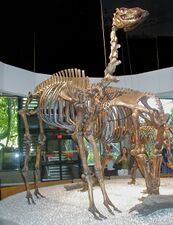 Camelops hesternus skeleton


الاستخدامات العسكرية
 مقالة مفصلة: سلاح الهجانة


By at least 1200 BC the first camel saddles had appeared, and Bactrian camels could be ridden. The first saddle was positioned to the back of the camel, and control of the Bactrian camel was exercised by means of a stick. However, between 500 and 100 BC, Bactrian camels came into military use. New saddles, which were inflexible and bent, were put over the humps and divided the rider's weight over the animal. In the seventh century BC the military Arabian saddle evolved, which again improved the saddle design slightly.[70][71]
Military forces have used camel cavalries in wars throughout Africa, the Middle East, and into the modern-day Border Security Force (BSF) of India (though as of July 2012, the BSF planned the replacement of camels with ATVs). The first documented use of camel cavalries occurred in the Battle of Qarqar in 853 BC.[72][73][74] Armies have also used camels as freight animals instead of horses and mules.[75][76]
The East Roman Empire used auxiliary forces known as dromedarii, whom the Romans recruited in desert provinces.[77][78] The camels were used mostly in combat because of their ability to scare off horses at close range (horses are afraid of the camels' scent),[11] a quality famously employed by the Achaemenid Persians when fighting Lydia in the Battle of Thymbra (547 BC).[47][79][80]
القرن 19 و 20

The United States Army established the U.S. Camel Corps, stationed in California, in the 19th century.[11] One may still see stables at the Benicia Arsenal in Benicia, California, where they nowadays serve as the Benicia Historical Museum.[81] Though the experimental use of camels was seen as a success (John B. Floyd, Secretary of War in 1858, recommended that funds be allocated towards obtaining a thousand more camels), the outbreak of the American Civil War in 1861 saw the end of the Camel Corps: Texas became part of the Confederacy, and most of the camels were left to wander away into the desert.[76]
France created a méhariste camel corps in 1912 as part of the Armée d'Afrique in the Sahara[82] in order to exercise greater control over the camel-riding Tuareg and Arab insurgents, as previous efforts to defeat them on foot had failed.[83] The Free French Camel Corps fought during World War II, and camel-mounted units remained in service until the end of French rule over Algeria in 1962.[84]
In 1916, the British created the Imperial Camel Corps. It was originally used to fight the Senussi, but was later used in the Sinai and Palestine Campaign in World War I. The Imperial Camel Corps comprised infantrymen mounted on camels for movement across desert, though they dismounted at battle sites and fought on foot. After July 1918, the Corps began to become run down, receiving no new reinforcements, and was formally disbanded in 1919.[85]
In World War I, the British Army also created the Egyptian Camel Transport Corps, which consisted of a group of Egyptian camel drivers and their camels. The Corps supported British war operations in Sinai, Palestine, and Syria by transporting supplies to the troops.[86][87][88]
The Somaliland Camel Corps was created by colonial authorities in British Somaliland in 1912; it was disbanded in 1944.[89]
Bactrian camels were used by Romanian forces during World War II in the Caucasian region.[90] At the same period the Soviet units operating around Astrakhan in 1942 adopted local camels as draft animals due to shortage of trucks and horses, and kept them even after moving out of the area. Despite severe losses, some of these camels ended up as far west as to Berlin itself.[91]
The Bikaner Camel Corps of British India fought alongside the British Indian Army in World Wars I and II.[92]
The Tropas Nómadas (Nomad Troops) were an auxiliary regiment of Sahrawi tribesmen serving in the colonial army in Spanish Sahara (today Western Sahara). Operational from the 1930s until the end of the Spanish presence in the territory in 1975, the Tropas Nómadas were equipped with small arms and led by Spanish officers. The unit guarded outposts and sometimes conducted patrols on camelback.[93][94]
مسابقة القرن 21
At the King Abdulaziz Camel Festival, in Saudi Arabia, thousands of camels are paraded and are judged on their lips and humps. The festival also features camel racing and camel milk tasting and has combined prize money of $57m (£40m). In 2018, 12 camels were disqualified from the beauty contest after it was discovered their owners had tried to improve their camel's good looks with injections of botox, into the animals' lips, noses and jaws.[95] In 2021 over 40 camels were disqualified for acts of tampering and deception in beautifying camels.[96]
المطبخ
اللبن

حليب النوق حليب ذو مواصفات عالية الجودة ويعتبر غذاء كامل للبدوي وسكان الصحراء عموما.
اللحم

التقارير الصحية
في الدين
في الإسلام
- مقالة مفصلة: الإبل في القرآن
في اليهودية
سلالات الجمال العربية

يمكن تصنيف سلالات الجمال ضمن أربع مجموعات هي:
- جمال الحليب: وهي متوسطة الحجم تتميز بإنتاج مرتفع من الحليب ( قد يصل إلى 2500كغ أو أكثر في الموسم). ومن أبرز سلالاتها الشلاغية والرشايدة في السودان، والسرتاوية والفاخرية في ليبيا، وأولاد سيدي الشيخ في موريتانيا والمغرب والجزائر.
- جمال اللحم: وتتميز بسرعة نموها وحجمها الكبير. ومن أبرز سلالاتها العربي في السودان والجندويل في موريتانيا ونجمال في تونس والفلاحي في مصر.
- الجمال الثنائية الغرض: وتنتج سلالاتها كميات متوسطة من الحليب واللحم، ومن أهمها جمال الهور والسيفدعر في الصومال، والمغاربية من المغرب حتى مصر والعرارات في السودان والمجاهيم ولوراك في السعودية، والشامية في البادية السورية.
- جمال السباق: وهي نحيفة الجسم طويلة القوائم، تستخدم في السباق في عدد من دول الخليج العربي وبعض الدول الإفريقية. ومن أبرز سلالاتها جمال المهارى والهجن العربية الأصيلة.
صفات الجمال
يتميز الجمل عن غيره من الحيوانات باجتماع إصبعيه في خف عريض يتسع عندما يطأ الأرض فيساعده على السير على الرمال الصحراوية الناعمة، ولذلك سميت الجمال بذوات الخف.
يمتلك الجمل مجموعة من الصفات تؤهله بجدارة لأن يسمى «سفينة الصحراء»، وهو عموما حيوان أنيس عديم المبالاة، إلا أنه يصبح شرساً إذا استثير، ويمكن أن يظهر غضباً ملحوظاً وخاصة إبان موسم التلقيح، وقد تعض الذكور المتشاجرة بعضها بعضاً عضاً مؤلماً.
تختلف ألوان الجمال من حمرة وكتمة وصفرة وبياض ودهمة وغيرها، وتتميز بقوائمها الطويلة ورقابها النحيلة الطويلة. رؤوسها صغيرة بالنسبة لأحجامها، وأعينها كبيرة تحميها من الغبار والرمال أجفان واضحة ورموش طويلة مقوسة، وآذانها صغيرة وسمعها جيد، وفتحاتها مغطاة بأشعار. ويستطيع الجمل إغلاق فتحتي أنفه لمقاومة الرمال التي تذروها الرياح، وجلده مغطى بأوبار تكون أطول في الجمال ذات السنامين منها في الجمال ذات السنام الواحد، وتسقط الأوبار في الربيع لتحل محلها أوبار جديدة في الخريف. وللجمل وسادات متقرنة سميكة على صدره وركبه تساعده على حمل ثقل جسمه عند القعود على الأرض.
تجتر الجمال الغذاء الذي تناولته مما قد يوحي أنها من المجترات، ولكنها ليست كذلك تماماً لكونها لا تمتلك المعدة الثالثة omasum. وعلى هذا فإن معدتها مركبة من ثلاث حجرات (بدلا من أربع كما في المجترات)، وتحتوي أولاها على أكياس صغيرة كانت تدعى خطأ «أكياس الماء» إذ كان يعتقد بأنها تخزن الماء بداخلها، وقد ثبت عدم صحة ذلك. ولا يمتلك الجمل حويصلاً صفراوياً ، وكريات دمه الحمراء بيضوية الشكل.
السنام hump مخزن هام للدهون، ففي حال التغذية الجيدة يخزن الجمل كميات من الدهن في سنامه لحين الحاجة إليها فيستخدمها مصدراً للغذاء والماء بعد تأكسدها.
يستطيع الجمل التغذي على الأعلاف الجافة والنباتات الشوكية على نحو جيد، وتساعده في ذلك شفته العليا المشقوقة نصفين، وهذا ما لا تستطيعه الأنواع الحيوانية الأخرى. ويمكن أن يتحمل نقص الغذاء والماء مدة أطول بكثير من حيوانات المزرعة، حتى أنه قد يفقد 25% من وزنه من دون أضرار كبيرة، ويستطيع أن يستعيد ما فقده من الماء بشرب كميات كبيرة منه قد تبلغ نحو مئة لتر في أقل من ربع ساعة. ويُعدَ ذلك ضاراً بالحيوانات الأخرى لما يسببه من مشكلات حلولية osmotic، ولكن الجمل يتحمل ذلك لأن الماء لا يمتص بسرعة من جهازه الهضمي ، فيتيح ذلك وقتاً كافياً لحدوث التوازن الحلولي في جسمه.
تسير الجمال ذات السنامين بسرعة أقل من الجمال ذات السنام الواحد، ولكنها أقوى على حمل الأثقال وتحمل المشاق، والثانية أكثر ارتفاعاً وأخف وزناً من الأولى، وتستخدم أساساً للركوب. تضع الأنثى مولوداً واحداً بعد مدة حمل تراوح بين 12 و14 شهراً، وتُرضعه نحو سنة. ويمكن أن يعيش مع أمه لعدة سنوات ما لم يُفصل عنها، فإذا فُصل عنها فهو فصيل. ويصبح الحيوان بالغاً بعمر 10 ـ 12 سنة، ويمكن أن يعمر مدة قد تصل إلى 40 عاماً.
يمتاز الجمل من الثدييات الأخرى بقدرة حرارة جسمه على التغير بين 34 - 41 درجة مئوية، ولا يبتدئ في التعرق حتى تبلغ درجة حرارة جسمه حداً مرتفعاً، مما يساعده على الإقلال من فقد الماء بالتبخر. أضف إلى ذلك أن بول الجمل مركز جداً وبرازه شبه جاف مما يساعد أيضاً على منع فقدان الماء. وجدير بالذكر أن الماء الذي يفقده من جسمه إنما يكون أساساً من أنسجة الجسم، مما يساعده على الاحتفاظ بسيولة الدم في حالة جيدة .
تخد الجمال عندما تجبر على الإسراع، والوخد هو سرعة متوسطة ترتفع القدمان اللتان على جانب واحد وتطآن الأرض معا.
الجمال عند العرب
ارتبط الجمل منذ القدم بحياة البدوي في الوطن العربي، فقد وصفه وذكر خصائصه ومراعيه ونباتاتها وأمراضه بدقة كبيرة، واستعمله العرب في أسفارهم وقوافل تجارتهم وتنقلاتهم. وكانوا قادرين دوماً على تمييز الجمال ذات الصفات الجيدة والاعتناء بها، وأوجدوا لها تسميات مختلفة، منها تسميات تبعاً لتطورها مع تقدمها بالعمر، متخذين الأسنان معياراً للتسمية، فمثلا أدرجت في «لسان العرب» لابن منظور التسميات الآتية:
«حوار»: أقل من سنة، «فصيل»: مفطوم في سنة أو أقل وفصل عن أمه، «ابن مخاض»: في السنة الثانية وتكون أمه حاملاً، «ابن لبون»: في الثالثة لأن أمه تكون ذات لبن أي ترضع أخاه، «حق»: إذا دخل السنة الرابعة لاستحقاقه أن يُحمل عليه، «جَذَع»: إذا استكمل الرابعة ودخل في الخامسة، «ثني»: إذا دخل في السادسة حيث تطلع الثنيتان الثابتتان، «رَبَاع»: إذا دخل في السابعة حيث تطلع الرباعيتان، «سديس»: إذا دخل في الثامنة حيث يطلع القارحان، «بازل»: إذا دخل في التاسعة فبزل ناباه، ويكون البعير قد بلغ أشده.
ومن ألوان الجمال التي أوردها الثعالبي: «إذا لم يُخالط حُمرة البعير شيء فهو أحمر، فإن خالطها السواد فهو أرمك، فإن كان أسود يخالط سواده بياض كدخان الرمث فهو أورق، فإن اشتد سواده فهو جَون، فإن كان أبيض فهو آدم، فإن خالطت بياضه حُمرة فهو أصهب، فإن خالطت بياضه شقرة فهو أعيس، فإن خالطت حُمرته صفرة وسواد فهو أحوى، فإن كان أحمر يخالط حمرته سواد فهو أكلف».
يقول الدميري إن الجمل كُنيَ بأبي أيوب دلالة على كثرة صبره، وإن من ألقاب الجمال، العيس: وهي الشديدة الصلبة، والشملال: وهي الخفيفة، واليعملة: وهي التي تعمل، والناجية: وهي السريعة، والعوجاء: وهي الضامرة، والشمرولة: وهي الطويلة، والهجان: وهي الجمال الكريمة، والكُوماء: وهي العظيمة السنام.
وقد جاء ذكر الجمال في الأمثال العربية، وقيل في إحداها: «أشبعهُم سبَاً وراحوا بالجمال» ويضرب لمن لم يكن عندهم إلا الكلام. وقيل أيضاً «ما هكذا يا سعد تُورد الجمال»، ويُضرب لمن تكلف أمراً لا يحسنه، وقيل في آخر: «لا ناقة لي ولا جمل» في أمر من الأمور لا يهم القائل.
وقال الطغرائي في المعنى نفسه:
فيم الإقامة بالزوراء لا سَكَني
فيها ولا ناقتي فيها ولا جملي
وقالت العرب أيضاً: «أطيب الجمال لبناً ما أكل السعدان»، والسعدان نبات له ثمر مستدير مشوك الوجه، وهو من خير مراعي الربيع. ويحتوي التراث على أسماء ووصف لكثير من الأشجار والشجيرات التي ترعاها الجمال مثل الطاح والسمر والحرز والسيال، وكلها أنواع من الأكاسي Acacia sp، والسدر والعاقول والشبرق، وغيرها.[97]
وقد عرف العرب كثيراً من أمراض الجمال ووصفوها مع طرق مداواتها. وكانت تُعد معياراً للثراء، واستخدموها في دفع الدية ومهوراً للزواج، كما كان حليبها ولحمها يستخدم في إكرام الضيف.
انظر أيضاً
المصادر
الهوامش
- ^ Burger, P. A.; Ciani, E.; Faye, B. (2019-09-18). "Old World camels in a modern world – a balancing act between conservation and genetic improvement". Animal Genetics. 50 (6): 598–612. doi:10.1111/age.12858. PMC 6899786. PMID 31532019.
- ^ Chuluunbat, B.; Charruau, P.; Silbermayr, K.; Khorloojav, T.; Burger, P. A. (2014). "Genetic diversity and population structure of Mongolian domestic Bactrian camels (Camelus bactrianus)". Anim Genet. 45 (4): 550–558. doi:10.1111/age.12158. PMC 4171754. PMID 24749721.
- ^ خطأ استشهاد: وسم
<ref>غير صحيح؛ لا نص تم توفيره للمراجع المسماةBernstein - ^ "Bactrian Camel: Camelus bactrianus". National Geographic. 10 May 2011. Archived from the original on 4 November 2012. Retrieved 28 November 2012.
- ^ "The amazing characteristics of the camels". Camello Safari. Archived from the original on 7 November 2012. Retrieved 26 November 2012.
- ^ "How Fast Can Camels Run and How Long Can They Run For?". Big Site of Amazing Facts. 17 April 2010. Retrieved 29 November 2012.
- ^ Fayed, R. H. "Adaptation of the Camel to Desert environment". ESARF. Archived from the original on 17 June 2022. Retrieved 21 April 2025.
- ^ Abu-Zidana, Fikri M.; Eida, Hani O.; Hefnya, Ashraf F.; Bashira, Masoud O.; Branickia, Frank (18 December 2011). "Camel bite injuries in United Arab Emirates: A 6 year prospective study". Injury. 43 (9): 1617–1620. doi:10.1016/j.injury.2011.10.039. PMID 22186231.
The male mature camel has a specialized inflatable diverticulum of the soft palate called the "Dulla". and During rutting the Dulla enlarges on filling with air from the trachea until it hangs out of the mouth of the camel and comes to resemble a pink ball. This occurs in only the one-humped camel. Copious saliva turns to foam covering the mouth as the male gurgles and makes metallic sounds. [6 cites to 5 references omitted]
- ^ Two Male Camels Fighting Over One Female. Youtube.com. Archived from the original on 2015-12-19. Retrieved 2016-01-08.
- ^ أ ب ت خطأ استشهاد: وسم
<ref>غير صحيح؛ لا نص تم توفيره للمراجع المسماةmukasa81 - ^ أ ب ت "Bactrian & Dromedary Camels". Factsheets. San Diego Zoo Global Library. March 2009. Archived from the original on 22 September 2012. Retrieved 4 December 2012.
- ^ أ ب "How much water does a camel's hump hold?". Library of Congress. Retrieved 2025-05-06.
- ^ Vann Jones, Kerstin. "What secrets lie within the camel's hump?". Sweden: Lund University. Archived from the original on 23 May 2009. Retrieved 7 January 2008.
- ^ Rastogi, S. C. (1971). Essentials Of Animal Physiology. New Age International. pp. 180–181. ISBN 9788122412796.
- ^ أ ب Roberts, Michael Bliss Vaughan (1986). Biology: A Functional Approach. Nelson Thornes. pp. 234–235, 241. ISBN 9780174480198.
- ^ UNESCO. "The Camel from Tradition To Modern Times" (PDF). Archived (PDF) from the original on 2015-11-09.
- ^ Crupi, Sarah (2021-04-06). "Truth or Tail: A camel's hump". www.clevelandzoosociety.org (in الإنجليزية). Retrieved 2025-08-04.
- ^ Eitan, A; Aloni, B; Livne, A (1976). "Unique properties of the camel erythrocyte membraneII. Organization of membrane proteins". Biochimica et Biophysica Acta (BBA) - Biomembranes. 426 (4): 647–58. doi:10.1016/0005-2736(76)90129-2. PMID 816376.
- ^ "Dromedary". Hannover Zoo. Archived from the original on 25 October 2005. Retrieved 8 January 2008.
- ^ أ ب ت Halpern, E. Anette (1999). "Camel". In Mares; Michael A. (eds.). Deserts. University of Oklahoma Press. pp. 96–97. ISBN 9780806131467. Archived from the original on 2016-04-29.
- ^ Breulmann, M., Böer, B., Wernery, U., Wernery, R., El Shaer, H., Alhadrami, G., ... Norton, J. (2007). "The Camel From Tradition to Modern Times" (PDF). UNESCO DOHA OFFICE.
- ^ أ ب Inside Nature's Giants. Channel 4 (UK) documentary. Transmitted 30 August 2011
- ^ "Arabian (Dromedary) Camel". National Geographic. National Geographic Society. 10 May 2011. Archived from the original on 19 November 2012. Retrieved 25 November 2012.
- ^ Lewis, Paul (12 July 1981). "A Pilgrimage To A Mystic's Hermitage In Algeria". The New York Times. Archived from the original on 4 August 2009. Retrieved 7 March 2009.
- ^ "Camels, llamas and alpacas". A manual for primary animal health care worker. FAO Animal Health Manual. FAO Agriculture and Consumer Protection. 1994. Archived from the original on 2008-07-27.
- ^ Fowler, M.E. (2010). Medicine and Surgery of Camelids, Ames, Iowa: Wiley-Blackwell.
- ^ Etemadi, A.A. (1966). "Diaphragm and os diaphragmaticum in Camelus dromedarius". Acta Anatomica. 65 (4): 551–560. doi:10.1159/000142904. ISSN 0001-5180.
- ^ Schmidt-Nielsen, K. (1964). Desert Animals: Physiological Problems of Heat and Water. New York: Oxford University Press (OUP). Cited in "Coat of fur on the camel". Davidson College. Archived from the original on February 25, 2003.
- ^ أ ب Bronx Zoo. "Camel Adaptations". Wildlife Conservation Society. Archived from the original (Flash) on 26 June 2012. Retrieved 29 November 2012.
- ^ Rundel, Philip Wilson; Gibson, Arthur C. (30 September 2005). "Adaptations of Mojave Desert Animals". Ecological Communities And Processes in a Mojave Desert Ecosystem: Rock Valley, Nevada. Cambridge University Press (CUP). p. 130. ISBN 9780521021418.
- ^ Silverstein, Alvin; Silverstein, Virginia B; Silverstein, Virginia; Silverstein Nunn, Laura (2008). Adaptation. Twenty-First Century Books. pp. 42–43. ISBN 9780822534341.
- ^ "Morphometric analysis of heart, kidneys and adrenal glands in dromedary camel calves (PDF Download Available)". ResearchGate (in الإنجليزية). Archived from the original on 2017-03-04. Retrieved 2017-03-03.
- ^ Rehan S and AS Qureshi, 2006. Microscopic evaluation of the heart, kidneys and adrenal glands of one-humped camel calves (Camelus dromedarius) using semi automated image analysis system. J Camel Pract Res. 13(2): 123
- ^ خطأ استشهاد: وسم
<ref>غير صحيح؛ لا نص تم توفيره للمراجع المسماةdavidson06 - ^ "Kidneys and Concentrated Urine". Temperature and Water Relations in Dromedary Camels (Camelus dromedarius). Davidson College. Archived from the original on February 25, 2003.
- ^ "Fun facts about the Camel". The Jungle Store. Archived from the original on 17 November 2012. Retrieved 3 December 2012.
- ^ خطأ استشهاد: وسم
<ref>غير صحيح؛ لا نص تم توفيره للمراجع المسماةfedewa00 - ^ أ ب ت Koenig, R. (2007). "'Camelized' Antibodies Make Waves". Veterinary Medicine. Science. 318 (5855): 1373. doi:10.1126/science.318.5855.1373. PMID 18048665. S2CID 71028674.
- ^ Sazmand, Alireza; Joachim, Anja (2017). "Parasitic diseases of camels in Iran (1931–2017) – a literature review". Parasite. EDP Sciences. 24: 1–15. doi:10.1051/parasite/2017024. ISSN 1776-1042. PMC 5479402. PMID 28617666. S2CID 13783061. Article Number 21.
- ^ Taylor, K.M.; Hungerford, D.A.; Snyder, R.L.; Ulmer Jr., F.A. (1968). "Uniformity of karyotypes in the Camelidae". Cytogenetic and Genome Research. 7 (1): 8–15. doi:10.1159/000129967. PMID 5659175.
- ^ Koulischer, L; Tijskens, J; Mortelmans, J (1971). "Mammalian cytogenetics. IV. The chromosomes of two male Camelidae: Camelus bactrianus and Lama vicugna". Acta Zoologica et Pathologica Antverpiensia. 52: 89–92. PMID 5163286.
- ^ Bianchi, N. O.; Larramendy, M. L.; Bianchi, M. S.; Cortés, L. (1986). "Karyological conservatism in South American camelids". Experientia. 42 (6): 622–4. doi:10.1007/BF01955563. S2CID 23440910.
- ^ Bunch, Thomas D.; Foote, Warren C.; Maciulis, Alma (1985). "Chromosome banding pattern homologies and NORs for the Bactrian camel, guanaco, and llama". Journal of Heredity. 76 (2): 115–8. doi:10.1093/oxfordjournals.jhered.a110034.
- ^ O'Brien, Stephen J.; Menninger, Joan C.; Nash, William G., eds. (2006). Atlas of Mammalian Chromosomes. New York: Wiley-Liss. p. 547. ISBN 978-0-471-35015-6.
- ^ Di Berardino, D.; Nicodemo, D.; Coppola, G.; King, A.W.; Ramunno, L.; Cosenza, G.F.; Iannuzzi, L.; Di Meo, G.P.; et al. (2006). "Cytogenetic characterization of alpaca (Lama pacos, fam. Camelidae) prometaphase chromosomes". Cytogenetic and Genome Research. 115 (2): 138–44. doi:10.1159/000095234. PMID 17065795. S2CID 21378633.
- ^ Balmus, Gabriel; Trifonov, Vladimir A.; Biltueva, Larisa S.; O'Brien, Patricia C.M.; Alkalaeva, Elena S.; Fu, Beiyuan; Skidmore, Julian A.; Allen, Twink; et al. (2007). "Cross-species chromosome painting among camel, cattle, pig and human: further insights into the putative Cetartiodactyla ancestral karyotype". Chromosome Research. 15 (4): 499–515. doi:10.1007/s10577-007-1154-x. PMID 17671843. S2CID 23226488.
- ^ أ ب Potts, Danel. "Bactrian Camels and Bactrian-Dromedary Hybrids". Silkroad. 3 (1). Archived from the original on 2016-06-23. Retrieved 2012-11-29.
- ^ Mohandesan, Elmira; Fitak, Robert R.; Corander, Jukka; Yadamsuren, Adiya; Chuluunbat, Battsetseg; Abdelhadi, Omer; Raziq, Abdul; Nagy, Peter; Stalder, Gabrielle (30 August 2017). "Mitogenome Sequencing in the Genus Camelus Reveals Evidence for Purifying Selection and Long-term Divergence between Wild and Domestic Bactrian Camels". Scientific Reports (in الإنجليزية). 7 (1): 9970. Bibcode:2017NatSR...7.9970M. doi:10.1038/s41598-017-08995-8. ISSN 2045-2322. PMC 5577142. PMID 28855525.
- ^ Ji, R; Cui, P; Ding, F; Geng, J; Gao, H; Zhang, H; Yu, J; Hu, S; Meng, H (August 2009). "Monophyletic origin of domestic bactrian camel (Camelus bactrianus) and its evolutionary relationship with the extant wild camel (Camelus bactrianus ferus)". Animal Genetics. 40 (4): 377–382. Bibcode:2009AnGen..40..377J. doi:10.1111/j.1365-2052.2008.01848.x. ISSN 0268-9146. PMC 2721964. PMID 19292708.
- ^ Stanley, H. F.; Kadwell, M.; Wheeler, J. C. (1994). "Molecular Evolution of the Family Camelidae: A Mitochondrial DNA Study". Proceedings of the Royal Society B: Biological Sciences. 256 (1345): 1–6. Bibcode:1994RSPSB.256....1S. doi:10.1098/rspb.1994.0041. PMID 8008753. S2CID 40857282.
- ^ Skidmore, J. A.; Billah, M.; Binns, M.; Short, R. V.; Allen, W. R. (1999). "Hybridizing Old and New World camelids: Camelus dromedarius x Lama guanicoe". Proceedings of the Royal Society B: Biological Sciences. 266 (1420): 649–56. doi:10.1098/rspb.1999.0685. PMC 1689826. PMID 10331286.
- ^ "Meet Rama the cama ..." BBC. 21 January 1998. Archived from the original on 23 October 2012. Retrieved 29 November 2012.
- ^ أ ب Fahmy, Miral (21 March 2002). "'Cama' camel/llama hybrids born in UAE research centre". Science in the News. The Royal Society of New Zealand. Archived from the original on 27 September 2013. Retrieved 28 November 2012.
- ^ Campbell, Duncan (15 July 2002). "Bad karma for cross llama without a hump". The Guardian. London. Archived from the original on 26 August 2013. Retrieved 2 March 2009.
- ^ "Joy for world's first camel and llama cross". Metro UK. 6 April 2008. Archived from the original on 25 November 2012. Retrieved 29 November 2012.
- ^ أ ب Harington, C. R. (June 1997). "Ice Age Yukon and Alaskan Camels". Yukon Beringia Interpretive Centre. Government of Yukon, Department of Tourism and Culture, Museums Unit. Archived from the original on 26 January 2013. Retrieved 3 December 2012.
- ^ أ ب Bernstein, William J. (6 May 2009). A Splendid Exchange: How Trade Shaped the World. Grove Press. pp. 54–55. ISBN 9780802144164.
- ^ "Poebrotherium" (PDF). North Dakota Industrial Commission Department of Mineral Resources. Archived from the original (PDF) on 25 July 2012. Retrieved 3 December 2012.
- ^ "Fossil camel skull (Poebrotherium sp.)". Science Buzz. Science Museum of Minnesota. January 2004. Archived from the original on 14 October 2012. Retrieved 3 December 2012.
- ^ Kindersley, Dorling (2 June 2008). "Camels". Encyclopedia of Dinosaurs and Prehistoric Life. Penguin. pp. 266–7. ISBN 9780756682415.
- ^ Lynch, Sinéad; Sánchez-Villagra, Marcelo R.; Balcarcel, Ana (December 2020). "Description of a fossil camelid from the Pleistocene of Argentina, and a cladistic analysis of the Camelinae". Swiss Journal of Palaeontology (in الإنجليزية). 139 (1): 5. Bibcode:2020SwJP..139....8L. doi:10.1186/s13358-020-00208-6. ISSN 1664-2376. PMC 7590954. PMID 33133011.
- ^ Heintzman, Peter D.; Zazula, Grant D.; Cahill, James A.; Reyes, Alberto V.; MacPhee, Ross D.E.; Shapiro, Beth (September 2015). "Genomic Data from Extinct North American Camelops Revise Camel Evolutionary History" (PDF). Molecular Biology and Evolution (in الإنجليزية). 32 (9): 2433–2440. doi:10.1093/molbev/msv128. ISSN 0737-4038. PMID 26037535.
- ^ أ ب Rybczynski, Natalia; Gosse, John C.; Richard Harington, C.; Wogelius, Roy A.; Hidy, Alan J.; Buckley, Mike (June 2013). "Mid-Pliocene warm-period deposits in the High Arctic yield insight into camel evolution". Nature Communications (in الإنجليزية). 4 (1): 1550. Bibcode:2013NatCo...4.1550R. doi:10.1038/ncomms2516. ISSN 2041-1723. PMC 3615376. PMID 23462993.
- ^ Singh; Tomar. Evolutionary Biology (8th revised ed.). New Delhi: Rastogi Publications. p. 334. ISBN 9788171336395.
- ^ Buckley, Michael; Lawless, Craig; Rybczynski, Natalia (March 2019). "Collagen sequence analysis of fossil camels, Camelops and c.f. Paracamelus, from the Arctic and sub-Arctic of Plio-Pleistocene North America" (PDF). Journal of Proteomics (in الإنجليزية). 194: 218–225. doi:10.1016/j.jprot.2018.11.014. PMID 30468917. S2CID 53713960.
- ^ Geraads, Denis; Didier, Gilles; Barr, Andrew; Reed, Denne; Laurin, Michel (April 2020). "The fossil record of camelids demonstrates a late divergence between Bactrian camel and dromedary=Acta Palaeontologica Polonica". Acta Palaeontologica Polonica (in الإنجليزية). 65 (2): 251–260. doi:10.4202/app.00727.2020. eISSN 1732-2421. ISSN 0567-7920.
- ^ Worboys, Graeme L.; Francis, Wendy L.; Lockwood, Michael (30 March 2010). Connectivity Conservation Management: A Global Guide. Earthscan. p. 142. ISBN 9781844076048.
- ^ MacPhee, Ross D. E.; Sues, Hans-Dieter (30 June 1999). Extinctions in Near Time: Causes, Contexts, and Consequences. Springer. pp. 18, 20, 26. ISBN 9780306460920.
- ^ Yuan, Junxia; Hu, Jiaming; Liu, Wenhui; Chen, Shungang; Zhang, Fengli; Wang, Siren; Zhang, Zhen; Wang, Linying; Xiao, Bo; Li, Fuqiang; Hofreiter, Michael; Lai, Xulong; Westbury, Michael V.; Sheng, Guilian (May 2024). "Camelus knoblochi genome reveals the complex evolutionary history of Old World camels". Current Biology (in الإنجليزية). 34 (11): 2502–2508.e5. Bibcode:2024CBio...34.2502Y. doi:10.1016/j.cub.2024.04.050. PMID 38754423.
{{cite journal}}: Check|pmid=value (help) - ^ Fagan, Brian M, ed. (2004). "Transportation". The Seventy Great Inventions of the Ancient World. London: Thames & Hudson. pp. 150–152. ISBN 978-0-500-05130-6.[صفحة مطلوبة]
- ^ Baum, Doug (1 November 2018). "The Art of Saddling a Camel". Saudi Aramco World. Retrieved 10 December 2018.
- ^ Gabriel, Richard A. (2007). Soldiers' Lives Through History: The Ancient World. Greenwood Publishing Group. p. xvi. ISBN 9780313333484.
- ^ Bhatia, Vimal (23 July 2012). "BSF to ditch camels to ride sand scooters". The Times of India. Archived from the original on 23 July 2012. Retrieved 4 December 2012.
- ^ Gann, Lewis Henry; Duignan, Peter (1972). Africa and the World: An Introduction to the History of Sub-Saharan Africa from Antiquity to 1840. University Press of America. p. 156. ISBN 9780761815204.
The camel was acclimatized in Egypt long before the time of Christ and was subsequently adopted by the Berbers of the desert, who used camel cavalry to fight the Romans. The Berbers spread the use of the camel across the Sahara.
- ^ Fleming, Walter L. (February 1909). "Jefferson Davis's Camel Experiment". The Popular Science Monthly. Vol. 74, no. 8. Bonnier Corporation. p. 150. ISSN 0161-7370. Archived from the original on 2016-05-04.
Other trials of the camel were made in 1859 by Major D. H. Vinton, who used twenty-four of them in carrying burdens for a surveying party...All in all, he concluded, the camel was much superior to the mule.
- ^ أ ب Mantz, John (20 April 2006). "Camels in the Cariboo". In Basque, Garnet (ed.). Frontier Days in British Columbia. Heritage House Publishing Co. pp. 51–54. ISBN 9781894384018. Archived from the original on 24 June 2016.
- ^ Southern, Pat (1 October 2007). The Roman Army: A Social and Institutional History. Oxford University Press. p. 123. ISBN 9780195328783.
- ^ Nicolle, David (26 March 1991). The Desert Frontier. Rome's Enemies. Vol. 5 (illustrated, reprint ed.). Osprey Publishing. p. 4. ISBN 9781855321663.
Nevertheless the military prowess of desert peoples impressed the Romans, who recruited large numbers as auxiliary cavalry and archers. In addition to providing the Roman Army with its best archers, the Easterners (largely Arabs but generally known as 'Syrians') served as Rome's most effective dromedarii or camel-mounted troops.
- ^ Herodotus (440 BC). The History of Herodotus. Rawlinson, George (trans.). Archived from the original on 1 December 2012. Retrieved 4 December 2012.
He collected together all the camels that had come in the train of his army to carry the provisions and the baggage, and taking off their loads, he mounted riders upon them accoutred as horsemen. These he commanded to advance in front of his other troops against the Lydian horse; behind them were to follow the foot soldiers, and last of all the cavalry. When his arrangements were complete, he gave his troops orders to slay all the other Lydians who came in their way without mercy, but to spare Croesus and not kill him, even if he should be seized and offer resistance. The reason why Cyrus opposed his camels to the enemy's horse was because the horse has a natural dread of the camel, and cannot abide either the sight or the smell of that animal. By this stratagem he hoped to make Croesus's horse useless to him, the horse being what he chiefly depended on for victory. The two armies then joined battle, and immediately the Lydian war-horses, seeing and smelling the camels, turned round and galloped off; and so it came to pass that all Croesus's hopes withered away.
{{cite book}}: CS1 maint: numeric names: authors list (link) - ^ "Cameliers and camels at war". New Zealand History online. History Group of the New Zealand Ministry for Culture and Heritage. 30 August 2009. Archived from the original on 16 March 2012. Retrieved 5 December 2012.
- ^ "The Posts at Benicia". The California State Military Museum. Archived from the original on 28 September 2012. Retrieved 4 December 2012.
- ^ "Vitrine N° 108 (partie droite): LES PELOTONS MEHARISTES" (in الفرنسية). Musée de l'infanterie. Archived from the original on 26 مايو 2013. Retrieved 5 ديسمبر 2012.
- ^ Hall, Bruce S. (6 June 2011). A History of Race in Muslim West Africa, 1600–1960. Cambridge University Press. p. 143. ISBN 9781107002876.
- ^ Guillaume, Philippe (16 June 2012). "L'incroyable épopée des méharistes français" [The incredible epic of the French méharistes]. BDSphère (in الفرنسية). Archived from the original on 22 May 2013. Retrieved 5 December 2012.
- ^ "Cameliers and camels at war". New Zealand History online. History Group of the New Zealand Ministry for Culture and Heritage. 30 August 2009. pp. 1, 2, 4, 5. Archived from the original on 16 March 2012. Retrieved 5 December 2012.
- ^ Woodward, David R. (2006). Hell in the Holy Land: World War I in the Middle East. University Press of Kentucky. pp. 36, 39, 43, 56, 133. ISBN 9780813123837.
- ^ Murray, Archibald James (1920). Sir Archibald Murray's despatches (June 1916 – June 1917). J.M. Dent. p. 123.
A great deal of the work of supplying the troops on both fronts has been done by the Camel Transport Corps
- ^ McGregor, Andrew James (30 May 2006). A Military History of Modern Egypt: From the Ottoman Conquest to the Ramadan War. Greenwood Publishing Group. p. 215. ISBN 9780275986018.
- ^ Federal Research Division (30 June 2004). Somalia a Country Study. Area handbook series (3rd ed.). Kessinger Publishing. pp. 230–231. ISBN 9781419147999.
- ^ "Romanian troops using camels". WWII in Color. Archived from the original on 2013-09-21.
- ^ "Наш советский верблюд покарает!". WARHEAD.SU. March 2, 2020.
- ^ Jupiter Infomedia Ltd (28 November 2012). "Bikaner Camel Corps, Presidency Armies in British India". IndiaNetzone.[dead link]
- ^ Shelley, Toby (December 2007). "Sons of the Clouds". Red Pepper. Location. Archived from the original on 20 May 2013. Retrieved 6 December 2012.
- ^ Hermandad de Veteranos Tropas Nómadas del Sáhara. "Los Medios" [The Means]. Historia: Agrupación de Tropas Nómadas (in الإسبانية). Archived from the original on 21 September 2013. Retrieved 6 December 2012.
- ^ "Camels banned from Saudi beauty contest over Botox". BBC News. 24 January 2018. Retrieved 26 August 2021.
- ^ Adams, Abigail (9 December 2021). "Over 40 Camels Disqualified From Beauty Contest in Saudi Arabia For Receiving Botox Injections". PEOPLE.com (in الإنجليزية).
- ^ أسامة عارف العوا. "الجمل". الموسوعة العربية.
الترميزات
- Vannithone S, Davidson A (1999). "Camel". The Oxford companion to food. Oxford Oxfordshire: Oxford University Press. p. 127. ISBN 0-19-211579-0.
- Camels and Camel Milk. Report Issued by FAO, United Nations. (1982)
- Wilson RT (1984). The camel. New York: Longman. ISBN 0-582-77512-4.
- The Technology of Making Cheese from Camel Milk (Camelus dromedarius) Animal Production and Health Paper Issued by FAO, United Nations. (2001)
قراءات أخرى
- Gilchrist, W. (1851) A Practical Treatise on the Treatment of the Diseases of the Elephant, Camel & Horned Cattle: with instructions for improving their efficiency; also, a description of the medicines used in the treatment of their diseases; and a general outline of their anatomy. Calcutta: Military Orphan Press
وصلات خارجية


- CS1 errors: PMID
- مقالات بالمعرفة بحاجة لذكر رقم الصفحة بالمصدر from February 2011
- CS1 maint: numeric names: authors list
- CS1 الفرنسية-language sources (fr)
- Articles with dead external links from November 2016
- CS1 الإسبانية-language sources (es)
- مقالات بالمعرفة تحتاج تمحيص الحقائق from February 2010
- جميع الصفحات التي تحتاج تمحيص حقائق
- Pages with empty portal template
- جمال
- إبل
- ماشية
- مطبخ أفريقي
- مطبخ الشرق الأوسط
- طعام حلال
- ألبان
- حيوانات مستأنسة
- حيوانات
- ثدييات
- حيوانات صحراوية
- وسيلة تنقل صحراوية