أسرة جين (266-420)
أسرة جين 晉朝 | |||||||||||||||
|---|---|---|---|---|---|---|---|---|---|---|---|---|---|---|---|
| 265–420 | |||||||||||||||
 أسرة جين الغربية (أصفر) في 280 م | |||||||||||||||
| الحالة | إمبراطورية | ||||||||||||||
| Capital | لوويانگ (265–311) چانگآن (312–316) جيانكانگ (317–420) | ||||||||||||||
| اللغات المشتركة | Old Chinese | ||||||||||||||
| الدين | البوذية، الطاوية، الكونفوشية، الديانة الشعبية الصينية | ||||||||||||||
| الحكومة | ملكية | ||||||||||||||
| إمبراطور | |||||||||||||||
• 265–290 م | إمبراطور وو جين | ||||||||||||||
• 419–420 م | الامبراطور گونگ من جين | ||||||||||||||
| مستشار | |||||||||||||||
| التاريخ | |||||||||||||||
• التأسيس | 265 | ||||||||||||||
• اعادة توحيد الصين تحت حكم جين | 280 | ||||||||||||||
• جين تنسحب إلى منطقة جنوب نهر هواي، وبذلك جين الشرقية تبدأ | 317 | ||||||||||||||
• التنازل لـليو سونگ | 420 | ||||||||||||||
| Population | |||||||||||||||
• 290 | 22,620,000 | ||||||||||||||
| العملة | عملة صينية، نقد | ||||||||||||||
| |||||||||||||||


أسرة جين (265-420) (الصينية المبسطة: 晋朝; الصينية التقليدية: 晉朝; پنين: Jìn Cháo; Wade–Giles: Chin⁴-ch'ao², IPA: [tɕîn tʂʰɑ̌ʊ]؛ إنگليزية: Jìn Dynasty)، هي أسرة حاكمة في التاريخ الصيني، وعاشت في الفترة من عام 265 و420 بعد الميلاد. وهناك قسمان رئيسيان في تاريخ الأسر الحاكمة، القسم الأول جين الغربية (باللغة الصينية: 西晉، في الفترة من 265 – 316) والقسم الثاني جين الشرقية (باللغة الصينية: 東晉، في الفترة من 317 – 420). وتم تأسيس جين الغربية على يد سيما يان (Sima Yan) وعاصمتها لوويانگ، بينما بدأت جين الشرقية على يد سيما روي (Sima Rui)، وعاصمتها جيانكانگ. ويُطلق الباحثون على هاتين الفترتين ليانگ جين (باللغة الصينية: 兩晉 lit، سيما جين لتمييز هذه الأسرة عن الأسر الأخرى التي تستخدم نفس الصفة الصينية، مثل أسرة جين التالية (باللغة الصينية: 後晉).
التأسيس
كانت عشيرة سيما (Sima) في بادئ الأمر فرعًا من أسرة وي، ولكن نما نفوذ هذه العشيرة وسلطانها إلى حد كبير بعد حادثة مقابر گاوپينگ في عام 249. وفي عام 265، أجبر سيما يان الإمبراطور تساو هوان (Cao Huan) حاكم وي على التنازل عن العرش له، لتنتهي وي وتبدأ جين (باسم الإمبراطور وو). وقد سمّى أسرته باسم مدينة جين التي تتبع فترة الربيع والخريف التي حكمت يومًا ما مقاطعة وين والتي كانت موطنًا لعشيرة سيما (Sima) وتقع في هىنـِيْ Henei (وفي يومنا هذا تعرف باسم مقاطعة ون، خنان). وفي عام 280، هزمت جين وو الشرقية ووحدت الصين، ولكن الصراعات الداخلية والفساد والاضطراب السياسي قوض أركان الأسرة الحاكمة بسرعة، واستمر الاتحاد لعشر سنوات فقط. وبظهور الإمبراطور الثاني لجين، الإمبراطور هوي (Hui)، حاول العديد من الأمراء الاستيلاء على السلطة في حرب الأمراء الثمانية المدمرة. ومن ثم جاءت انتفاضة وو هو (Wu Hu) والتي فرت خلالها أعداد كبيرة من اللاجئين إلى الجنوب في حين احتل الشمال من قبل جماعات البدو المختلفة. وكانت هذا دليلاً على نهاية عهد أسرة جين الغربية عام 316 عندما تم إخلاء بلاط جين إلى الجنوب من منطقة نهر هواي، وبداية عهد جين الشرقية وفترة الممالك الستة عشر.
وأسس سيما روي جين الشرقية في جيانكانگ في عام 317، وقد امتدت أراضيها في معظم أنحاء جنوب الصين اليوم. ويسمى في بعض الأحيان المزيج من فترة جين الشرقية والممالك الستة عشر باسم جين الشرقية والممالك الستة عشر (باللغة الصينية: 東晉十六國). وخلال هذه الفترة، انتقلت أعداد كبيرة من الناس إلى الجنوب نزوحًا من الأرض المنبسطة المركزية، تحفيزًا لتنمية جنوب الصين. وكان أباطرة جين الشرقية محدودي السلطة، حيث تركزت معظم السلطة في أيدي الأسرة الحاكمة، في حين كانت القوة العسكرية في يد أفراد ليسوا من العائلة المالكة. وبدأ العديد من أفراد فانگ تشن (باللغة الصينية:方鎮 lit. مقاطعة عسكرية) في التطلع للحكم مما أدى إلى الثورات العسكرية، مثل حركات التمرد من وانگ دون (Wang Dun) وسو جون (Su Jun) وديكتاتورية هوان ون (Huan Wen). وعلى الرغم من وجود هدف معلن من استعادة "الأراضي الشمالية المفقودة"، أدى جنون العظمة داخل العائلة المالكة والسلسلة المستمرة من الصراعات على العرش إلى فقد دعم العديد من المسؤولين. وفي عام 383، حشدت چين السابقة جنودها وعقدت العزم على هزيمة جين الشرقية. وخوفًا من مواجهة التهديد بالغزو، تعاون العديد من المسؤولين في جين على أمل صد الهجوم. وبعد معركة نهر فـِيْ، كان بمقدور شيى آن (Xie An) وشيى شوان (Xie Xuan) وغيرهما من الجنرالات صد الهجوم على تشين واستعادة مجموعة كبيرة من الأراضي من عدوهم. ومع ذلك، وقعت معارك سياسية داخلية كثيرة من قبل مجموعات مختلفة من المسؤولين بعد اغتصاب السلطة من هوان شوان (Huan Xuan) وإجباره على التخلي عن العرش. ونظرًا لمعاناة الإدارة المدنية، وقعت العديد من الثورات على يد سون أون (Sun En) ولو شيون (Lu Xun) والإعلان عن المملكة الجديدة التي أطلق عليها اسم شو الغربية عن طريق القائد العسكري چياو زونگ (Qiao zong) في إقليم شو التابعة لجين الشرقية. وفي نهاية الأمر، أدت انتفاضة ليو يو (Liu Yu) إلى وقوع فوضى كبرى أعقبها توليه للعرش، ليضع نهاية لحكم أسرة جين وبداية حكم أسرة ليو سونگ (Liu Song) وفترة الأسر الجنوبية والشمالية في التاريخ الصيني
التاريخ
 مقالة مفصلة: تاريخ أسرة جين (266-420)
خلفية
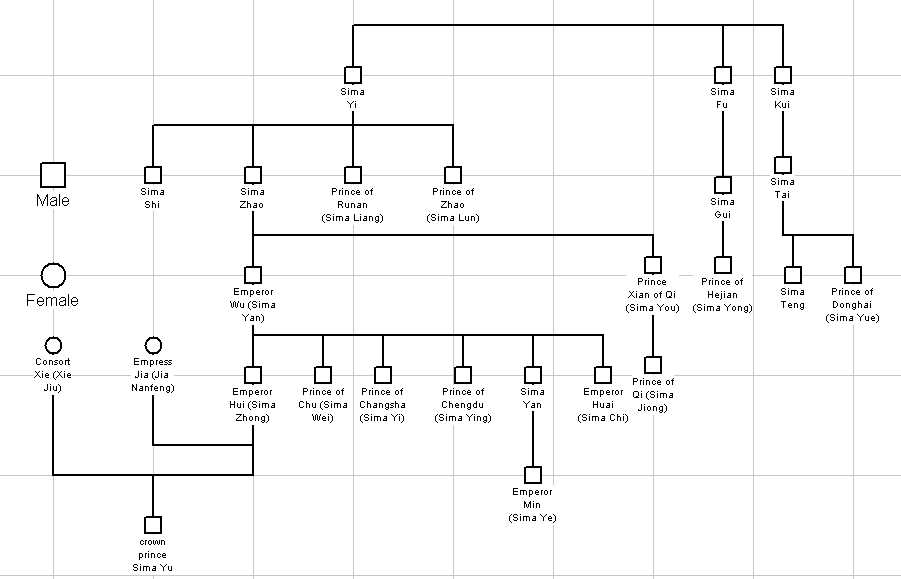
During the Three Kingdoms period, the Sima clan—with its most accomplished individual being Sima Yi—rose to prominence within the kingdom of Cao Wei that dominated northern China. Sima Yi was the regent of Cao Wei, and in 249 he instigated a coup d'état known as the Incident at the Gaoping Tombs, after which the Sima clan began to surpass the imperial Cao clan's power in the kingdom. After Sima Yi's death in 251, Sima Yi's eldest son Sima Shi succeeded his father as regent of Cao Wei, maintaining the Sima clan's tight grip on the Cao Wei political scene. After Sima Shi's death in 255, Sima Shi's younger brother Sima Zhao became the regent of Cao Wei. Sima Zhao further assisted his clans' interests by suppressing rebellions and dissent.[1]
In 263, he directed Cao Wei forces in conquering Shu Han and capturing Liu Shan (the son of Liu Bei), marking the first demise of one of the Three Kingdoms. Sima Zhao's actions awarded him the title of King of Jin, the last achievable rank beneath that of emperor. He was granted the title because his ancestral home was located in Wen County, on the territory of the Zhou-era state of Jin, which was centered on the Jin River in Shaanxi. Sima Zhao's ambitions for the throne were visible, but he died in 265 before any usurpation attempt could be made, passing the opportunity to his ambitious son Sima Yan.[2]
جين الغربية (266–316)
التأسيس والتوحيد
.jpg&filetimestamp=20260622133648&)

تم تأسيس أسرة جين الغربية (باللغة الصينية: 西晉، في الفترة من 265 – 316) على يد الإمبراطور وو (Wu) المعروف باسم سيما يان. على الرغم من تميزها بفترة وجيزة من الوحدة بعد هزيمة وو الغربية في عام 280، عانت جين من حرب مدنية مدمرة، حرب الأمراء الثمانية، والتي لم يتمكنوا بعدها من احتواء ثورة القبائل البدوية المعروفة باسم وو هو. وتم الاستيلاء على العاصمة لوويانگ في عام 311، وتم القبض على الإمبراطور هواي. كما تم إلقاء القبض على خليفته، الإمبراطور مين (Min) في چانگآن في عام 316.
وفر باقي حاشية جين إلى الشرق وأعيد تشكيل الحكومة في جيانكانغ، التي تقع بالقرب من نانجينگ الموجودة في الوقت الحالي، وذلك تحت سلطة أحد أفراد العائلة الملكية الذي أطلق عليه أمير لانجيي. وتم الإعلان عن الأمير الإمبراطور يوان الذي يتبع أسرة جين الغربية (باللغة الصينية: 東晉 317–420) بعدما وصلت أنباء سقوط تشانغآن إلى الجنوب. (يقع نهر وو هو في الشمال، والتي لا تعترف بشرعية جين، وتشير أحيانًا إليها باسم "لانجيي".)

لقد كانت الأزمات العسكرية، مثل حركات التمرد التي قادها جنرالات مثل وانگ دون (Wang Dun) وسو جون (Su Jun) سببًا في معاناة جين الشرقية خلا فترة وجودها البالغة 104 سنة. ومع ذلك، تحولت معركة نهر فاي إلى نصر مظفر لجين، نظرًا للتعاون قصير الأجل بين هوان تشونگ (Huan Chong)، الأخ الأكبر للجنرال هوان ون (Huan Wen) ورئيس الوزراء شيى آن (Xie An). وبعد ذلك، اغتصب هوان شوان (Huan Xuan)، ابن هوان ون (Huan Wen)، السلطة ليجلس على العرش وغير اسم الأسرة إلى تشو (Chu). وتم خلعه بعد ذلك عن طريق ليو سونگ (Liu Song)، الذي أعاد الإمبراطور يان (An), وأمر بشنق نفسه وتنصيب أخيه الإمبراطور گونگ (Gong) في عام 419.
وتنازل الإمبراطور گونگ (Gong) في عام 420 لصالح ليو يو (Liu Yu)، معلنا في أسرة ليو سونگ (Liu Song) عن أول أسرة من الأسر الجنوبية. وبهذا انتهت أسرة جين.
وفي هذه الأثناء، كانت شمال الصين واقعة تحت حكم الممالك الستة عشر، التي تم تأسيس العديد منها على يد وو هو (Wu Hu). وكان آخرها، ليانغ الشمالية، التي تمت هزيمتها على يد أسرة وي الشمالية في عام 439، وكان هذا إيذانًا ببدء فترة الأسر الشمالية.
Following the unification, China entered a decade of peace and economic prosperity, with accounts detailing the extravagant and outlandish lifestyles of the aristocracy. Internally, Emperor Wu upheld Confucian primogeniture by decreeing that his eldest son, Sima Zhong, posthumously known as Emperor Hui, would succeed him to the throne, despite his apparent developmental disability. To protect his heir and dynasty, he empowered his princes and dukes by appointing them to important military and administrative positions.[3] Meanwhile, a few officials also began expressing concerns regarding the growing population and treatment of the various non-Han peoples ("Five Barbarians") that had been resettling in northern China for centuries.[4]
الاضمحلال
Emperor Wu died in 290, and Emperor Hui's ascension began the War of the Eight Princes. In 291, Emperor Hui's wife, Empress Jia, seized power and began ruling the empire behind her husband's throne. Under her rule, the affluence of the aristocracy went unchecked, and corruption ran rampant within the government. She and her family were overthrown in a coup in 300, but a series of civil wars soon broke out between the Sima princes for the regency and succession of Emperor Hui, devastating most of northern China and the imperial military.[5]
The short-lived unification of China came to an end in 304; that year, the Cheng-Han and Han-Zhao declared their independence from Jin. The Upheaval of the Five Barbarians carried on the chaos from the War of the Eight Princes, as uprisings and famines continued to erode Jin authority in the north. In 311, the Jin capital Luoyang was sacked by Han-Zhao forces under Liu Cong, and Sima Chi, posthumously known as Emperor Huai, was captured and later executed. Emperor Huai's successor Sima Ye, posthumously known as Emperor Min, was then also captured and executed by Han-Zhao when they seized Chang'an (present-day Xi'an) in 316, marking the end of the Western Jin.[6] The surviving members of the Jin imperial family, as well as large numbers of Han Chinese from the North China Plain, subsequently fled to southern China. These refugees had a large impact on the lands they moved to—for example, they gave Quanzhou's Jin River its name upon their settlement there.[7]
جين الشرقية (317-420)

.jpg&filetimestamp=20260622133555&)
التأسيس
After the fall of Chang'an and the execution of Emperor Min of Jin, Sima Rui, posthumously known as Emperor Yuan, was enthroned as Jin emperor in 318. He reestablished the Jin government at Jiankang (modern Nanjing), which became the dynasty's new capital and marked the beginning of the Eastern Jin period.[6] Since one of Sima Rui's titles was the prince of Langya, the newly established northern states, which denied the legitimacy of his succession, sometimes referred to his empire as "Langya".
The Eastern Jin period saw the peak of menfa (門閥 'gentry clan') politics. The authority of the emperors was limited, while national affairs were controlled by powerful immigrant elite clans like the Wang (王) clans of Langya and Taiyuan, the Xie (謝) clan of Chenliu, the Huan (桓) clan of Qiao Commandery, and the Yu (庾) clan of Yingchuan. Among the people, a common remark was that "Wang Dao and Sima Rui, they dominate the nation together" (王與馬,共天下).[10] It was said that when Emperor Yuan was holding court, he even invited Wang Dao to sit by his side so they could jointly accept congratulations from ministers, but Wang Dao declined the offer.[11]
الحروب مع الشمال
In order to recover the lands lost during the fall of the Western Jin, the Eastern Jin dynasty launched several military campaigns against the northern states, such as the expeditions led by Huan Wen from 354 to 369. Most notably, in 383, a heavily outnumbered Eastern Jin force inflicted a devastating defeat on the state of Former Qin at the Battle of Fei River. After this battle, the Former Qin—which had recently unified northern China—began to collapse, and the Jin dynasty recovered the lands south of the Yellow River. Some of these lands were later lost, but the Jin regained them once more when Liu Yu defeated the northern states in his northern expeditions of 409–416.
Despite successes against the northern states like the Battle of Fei River, paranoia in the royal family and a constant disruptions to the throne often caused loss of support for northern campaigns. For example, lack of support by the Jin court was a major cause of Huan Wen's failure to recover the north in his expeditions. Additionally, internal military crises—including the rebellions of generals Wang Dun and Su Jun, but also lesser fangzhen (方鎮 'military command') revolts—plagued the Eastern Jin throughout its 104-year existence.
الهجرة الجماعية إلى الجنوب
The local aristocrat clans of the south were often at odds with the immigrants from the north. As such, tensions increased, and rivalry between the immigrants and southern locals loomed large in the domestic politics of the Jin. Two of the most prominent local clans, the Zhou (周) clan of Yixing and the Shen (沈) clan of Wuxing, were dealt a bitter blow from which they never quite recovered. There was also conflict between the various northern immigrant clans. This led to a virtual balance of power, which somewhat benefited the emperor's rule.
Special "commanderies of immigrants" and "white registers" were created for the massive amounts of northern Han Chinese who moved south during the Eastern Jin.[12] The southern Chinese aristocracy was formed from the offspring of these migrants.[13] Particularly in the Jiangnan region, Celestial Masters and the nobility of northern China subdued the nobility of southern China during the Jin dynasty.[14] Southern China overtook the north in population due to depopulation of the north and the migration of northern Chinese to southern China.[15][16] Different waves of migration of aristocratic Chinese from northern China to the south at different times resulted in distinct groups of aristocratic lineages.[17]

الزوال
In 403, Huan Xuan, the son of esteemed general Huan Wen, usurped the Jin throne and declared the dynasty of Huan Chu. Huan Xuan was soon toppled by Liu Yu, who reinstated Jin rule by installing Sima Dezong on the throne, posthumously known as Emperor An. Meanwhile, the civilian administration suffered, as there were further revolts led by Sun En and Lu Xun, and Western Shu became an independent kingdom under Qiao Zong. In 419, Liu Yu had Sima Dezong strangled and replaced by his brother Sima Dewen, posthumously known as Emperor Gong. Finally, in 420, Sima Dewen abdicated in favour of Liu Yu, who declared himself the ruler of the new Song dynasty (which is referred to as the Liu Song dynasty by historians in order to prevent confusion with the Song dynasty established in 960). Sima Dewen was then asphyxiated with a blanket in the following year. In the north, Northern Liang, the last of the Sixteen Kingdoms, was conquered by Northern Wei in 439, ushering in the Northern dynasties period.
The Xianbei Northern Wei accepted the Jin refugees Sima Fei (司馬朏) and Sima Chuzhi (司馬楚之). They both married Xianbei princesses. Sima Fei's wife was named Huayang (華陽公主), who was a daughter of Emperor Xiaowen; Sima Chuzhi's son was Sima Jinlong, who married a Northern Liang princess who was a daughter of the Lushuihu king Juqu Mujian.[18] More than fifty percent of Tuoba Xianbei princesses of the Northern Wei were married to southern Han Chinese men from the imperial families and aristocrats from southern China of the Southern dynasties who defected and moved north to join the Northern Wei.[19] Much later, Sima Guang (1019–1086), who served as chancellor for the Song and created the comprehensive history Zizhi Tongjian, claimed descent from the Jin dynasty (specifically, Sima Fu, brother of Sima Yi).
Society and culture
Religion

Taoism was polarised in the Jin dynasty. The Jin emperors repressed Taoists harshly, but also tried to exploit it, given the way it had been used near the end of the Han era in the Yellow Turban Rebellion. Amidst the political turmoil of the era, many successful merchants, small landowners, and other moderately comfortable people found great solace in Taoist teachings and a number of major clans and military officers also took up the faith. Ge Hong emphasized loyalty to the emperor as a Taoist virtue; he even taught that rebels could never be Taoist immortals,[20] which made Taoism more palatable to the imperial hierarchy. As a result, popular Taoist religions were considered heterodoxy while the official schools of the court were supported, but the popular schools like the Tianshi Dao (Way of the Celestial Masters) were still secretly held dear and promulgated amongst ordinary people.[citation needed]
While the religion had been in China since the 1st century CE, the chaos of the Sixteen Kingdoms made Buddhism more popular, in part due to the non-Chinese finding solace in a foreign teaching and the focus on addressing suffering. With the northern states sponsoring the spread of Buddhism, the teaching soon permeated to the south as monks such as Zhi Dun and Dao'an engaged in scholarly "pure conversation" (清談; Qīngtán) debates with the ruling elites, marking a critical era for the Mahayana school in China. Even before the fall of Western Jin and Kumārajīva's 5th-century translations, there was the early and important translation of the Lotus Sutra by the monk Dharmarakṣa in 286. It was said that there were 1,768 Buddhist temples in the Eastern Jin.[21][22]
Furthermore, Taoism advanced chemistry and medicine in China, whereas the contribution of Mahayana was concentrated in philosophy and literature.[citation needed]

الثقافة المادية
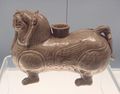
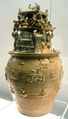
The Jin dynasty is well known for the quality of its greenish celadon porcelain wares, which immediately followed the development of proto-celadon. Jar designs often incorporated animal, as well as Buddhist, figures.[23] Examples of Yue ware are also known from the Jin dynasty.[24]
-

-
 Pottery tower, Western Jin, 265–317 CE.
 -
-
 Celadon lian bowl with Buddhist figures, Western Jin, 265–317 CE.
 -


صناعة الخزف عند جين

من المعروف جيدًا أن عهد أسرة جين تميز بجودة الأواني الفخارية السيلادون الخضراء المصنوعة من الخزف، التي جاءت بشكل مباشر بعد تطور سلادون الأولية. وتتضمن تصميمات الأواني الفخارية أشكال الحيوانات وأشكال بوذا وأشكال أخرى.[25]
نماذج من أواني يوي الفخارية المعروفة كذلك من أسرة جين.[26]
-
-
Celadon Lian bowl with Buddhist figures, جين الغربية، 265-317م.
-
 Celadon jar, جين الشرقية، 317-420م.
 -
 Celadon jar with brown spots, جين الشرقية، 317-420م.


الشكل
أباطرة أسرة جين
 | |||||||||||||||||||||||||||||||||||||||||||||||||||||||||||||||||||||||||||||||||||||||||||||||||||||||||||||||||||||||||||||||||||||||||||||||||
|---|---|---|---|---|---|---|---|---|---|---|---|---|---|---|---|---|---|---|---|---|---|---|---|---|---|---|---|---|---|---|---|---|---|---|---|---|---|---|---|---|---|---|---|---|---|---|---|---|---|---|---|---|---|---|---|---|---|---|---|---|---|---|---|---|---|---|---|---|---|---|---|---|---|---|---|---|---|---|---|---|---|---|---|---|---|---|---|---|---|---|---|---|---|---|---|---|---|---|---|---|---|---|---|---|---|---|---|---|---|---|---|---|---|---|---|---|---|---|---|---|---|---|---|---|---|---|---|---|---|---|---|---|---|---|---|---|---|---|---|---|---|---|---|---|---|
القديم
| |||||||||||||||||||||||||||||||||||||||||||||||||||||||||||||||||||||||||||||||||||||||||||||||||||||||||||||||||||||||||||||||||||||||||||||||||
الامبراطوري
| |||||||||||||||||||||||||||||||||||||||||||||||||||||||||||||||||||||||||||||||||||||||||||||||||||||||||||||||||||||||||||||||||||||||||||||||||
المعاصر
| |||||||||||||||||||||||||||||||||||||||||||||||||||||||||||||||||||||||||||||||||||||||||||||||||||||||||||||||||||||||||||||||||||||||||||||||||
| اسم بعد الموت | اسم عائلة و أسماء أولى | فترات الحكم | أسماء العهود وفتراتها |
|---|---|---|---|
| التقليد الصيني: "جين" + الاسم بعد الوفاة + "دي" | |||
| أسرة جين الغربية 265–316 | |||
| وو دي | سيما يان | 266–290 |
|
| Hui Di | Sima Zhong | 290–307 |
|
| none | سيما لون | 301 |
|
| Huai Di | Sima Chi | 307 – 311 |
|
| Min Di | Sima Ye | 313–316 |
|
| Eastern Jìn Dynasty 317–420 | |||
| Yuan Di | سيما روي | 317–323 |
|
| Ming Di | سيما شاو | 323–325 |
|
| Cheng Di | سيما يان | 325–342 |
|
| Kang Di | سيما يوى | 342–344 |
|
| Mu Di | سيما دان | 344–361 |
|
| Ai Di | سيما پي | 361–365 |
|
| Fei Di | سيما يي | 365–372 | *Taihe 365–372 |
| Jianwen Di | سيما يو | 372 |
|
| Xiaowu Di | سيما ياو | 372–396 |
|
| An Di | Sima Dezong | 396–419 |
|
| Gong Di | Sima Dewen | 419–420 |
|
الهوامش
- ^ de Crespigny, Rafe (2019). Dien, Albert E.; Knapp, Keith N. (eds.). The Cambridge History of China: Volume 2: The Six Dynasties, 220–589. The Cambridge History of China. Vol. 2. Cambridge: Cambridge University Press. pp. 47–48. doi:10.1017/9781139107334. ISBN 978-1-107-02077-1.
- ^ A-Xiang, Hu (2024-09-16). The Origin and Evolution of China's Names I: The Reigning Dynasties (in الإنجليزية) (1 ed.). London: Routledge. doi:10.4324/9781003510390-9. ISBN 978-1-003-51039-0.
- ^ Cosmo, Nicola Di (2011-03-04). Military Culture in Imperial China (in الإنجليزية). Harvard University Press. p. 115. ISBN 978-0-674-26299-7.
- ^ Declercq, Dominik, ed. (2025). A prince of martial splendour in the sixteen kingdoms: Li Hao (351-417), ruler of western Liang. Sinica Leidensia. Leiden ; Boston: Brill. pp. 11–16. ISBN 978-90-04-72738-0.
- ^ Graff, David Andrew (2002). Medieval Chinese warfare, 300-900. Warfare and history. London ; New York: Routledge. pp. 44–47. ISBN 978-0-415-23954-7.
- ^ أ ب Grousset, Rene (1970). The Empire of the Steppes. Rutgers University Press. pp. 56–57. ISBN 978-0-8135-1304-1.
- ^ Moser, Leo J. (1985). "13 The Seagoing Minnan Peoples: Historic Quanzhou, Marco Polo's "Zaitun"". The Chinese Mosaic: The Peoples and Provinces of China. Westview Press, Inc. ISBN 978-0-367-29083-2.
- ^ Dien, Albert E. (2007). Six Dynasties Civilization (in الإنجليزية). Yale University Press. pp. 295–296. ISBN 978-0-300-07404-8.
- ^ Watt, James C. Y. (2004). China: Dawn of a Golden Age, 200–750 AD (in الإنجليزية). Metropolitan Museum of Art. p. 159. ISBN 978-1-58839-126-1.
- ^ Fang Xuanling; et al., eds. (1974) [648]. Book of Jin 晉書. Beijing: Zhonghua Shuju. vol. 98, biography of Wang Dun.
帝初鎮江東,威名未著,敦與從弟導等同心翼戴,以隆中興,時人為之語曰:「王與馬,共天下。」
- ^ "Sima Rui" 司马睿. Office of the Committee for Local Records, Jiangsu Province. 2014. Archived from the original on 2 February 2017. Retrieved 28 January 2017.
- ^ Gernet (1996), p. 182.
- ^ Tackett, Nicolas Olivier (2006). The Transformation of Medieval Chinese Elites (850–1000 C.E.) (PDF) (PhD thesis). Columbia University. p. 81. Archived from the original (PDF) on 4 March 2016.
- ^ Wang Chengwen (2009). "The Revelation and Classification of Daoist Scriptures". In John Lagerwey; Lü Pengzhi (eds.). Early Chinese Religion: The Period of Division (220–589 AD). Vol. 2. Brill. p. 831. doi:10.1163/ej.9789004175853.i-1564.98. ISBN 978-90-04-17585-3.
- ^ Haywood, John (2000). Historical Atlas of the Classical World, 500 BC–AD 600. Barnes & Noble Books. p. 2.25. ISBN 978-0-7607-1973-2.
- ^ Haywood, John; Jotischky, Andrew; McGlynn, Sean (1998). Historical Atlas of the Medieval World, AD 600–1492. Barnes & Noble. p. 3.21. ISBN 978-0-7607-1976-3.
- ^ Hugh R. Clark (2007). Portrait of a Community: Society, Culture, and the Structures of Kinship in the Mulan River Valley (Fujian) from the Late Tang Through the Song. Chinese University Press. pp. 37–38. ISBN 978-962-996-227-2.
- ^ Watt, James C.Y. (2004), China: Dawn of a Golden Age, 200–750 AD, Metropolitan Museum of Art, p. 18 ff, ISBN 978-1-58839-126-1, https://books.google.com/books?id=JbdS-R3y72MC&pg=PA18
- ^ Tang, Qiaomei (May 2016). Divorce and the Divorced Woman in Early Medieval China (First through Sixth Century) (PDF) (PhD thesis). Cambridge, Massachusetts: Harvard University. pp. 151–153.
- ^ Baopuzi, Vol. 3.
欲求仙者,要當以忠孝和順仁信為本。若德行不修,而但務方術,皆不得長生也。
- ^ 「東晉偏安一百四載,立寺乃一千七百六十有八,可謂侈盛……」Liu Shiheng (劉世珩,1874–1926) 南朝寺考 quoted from 釋迦氏譜
- ^ Zürcher, Erik; Teiser, Stephen F. (2007). The Buddhist conquest of China: the spread and adaptation of Buddhism in early medieval China. Sinica Leidensia (3rd ed.). Leiden: Brill. ISBN 978-90-474-1942-6.
- ^ Shanghai Museum permanent exhibit
- ^ Guimet Museum permanent exhibit
- ^ معرض دائم في متحف شانغهاي
- ^ Guimet Museum permanent exhibit
أحداث هامة
انظر أيضاً
- Chinese sovereign
- گى هونگ
- قائمة دافعي الجزية للصين الامبراطورية
- أسرة ليو سونگ
- الأسرات الشمالية
- أسرة وِيْ الشمالية
- غراميات الممالك الثلاث
- الأسرات الست
- الممالك الستة عشر
- الأسرات الجنوبية
المصادر
- Gernet, Jacques (1990). Le monde chinois. Paris: Armand Colin.
وصلات خارجية

- Chinese History, the Jin Dynasty 晉
- Largest Jin Dynasty Tomb Discovered in NW China
- Early Imperial China: A Working Collection of Resources
- History of China: A good catalogue of info
| سبقه الممالك الثلاثة |
الأسرات في تاريخ الصين 265–420 |
تبعه الأسر الجنوبية والشرقية |
- CS1 uses الصينية-language script (zh)
- Harv and Sfn no-target errors
- Pages using infobox country with unknown parameters
- مقالات تحتوي نصوصاً باللغة الصينية المبسطة
- مقالات تحتوي نصوصاً باللغة الصينية التقليدية
- Articles containing إنگليزية-language text
- Pages using Lang-xx templates
- Articles with hatnote templates targeting a nonexistent page
- Articles containing صينية-language text
- Articles with unsourced statements from May 2024
- دول وأراضي تأسست في 265
- أسرة جين (265-420)
- الممالك الستة عشر
- تأسيسات 265
- انحلالات 420