أدولف ليبشر
أدولف ليبشر | |
|---|---|
Adolf Liebscher | |
 Adolf Liebscher, by Jan Vilímek (1887) | |
| وُلِدَ | 11 مارس 1857 |
| توفي | 11 يونيو 1919 |
| المهنة | رسام تاريخ |
| التوقيع | |
 | |
أدولف ليبشر[needs Czech IPA] ( Adolf Liebscher ؛ 11 مارس 1857، في پراگ، الإمبراطورية النمساوية – 11 يونيو 1919، في Potštejn) كان رسام تاريخ تشيكي.[1]
الحياة والعمل
بعد إكمال تعليمه في المدارس المحلية، ذهب ليبشر إلى ڤيينا، حيث التحق بكورس لثلاثة سنوات لمعلمي الرسم على يد فرديناند لاوفبرگر.[1] He then spent six months preparing to enter a competition for the creation of decorations in the foyer at the National Theater. He received the Second Prize, and his drawings were used for the lunettes. Afterwards, he spent several months in Italy.
 |
._Vy%C5%A1ehradsk%C3%BD_h%C5%99bitov._(109).jpg)
Upon his return, he received a series of public commissions, including work at the Rudolfinum, the municipal union hall in Písek and the government office buildings in Vinohrady and Vyškov.[1] He became a teacher at the Technical University in 1879, was promoted to Associate Professor in 1895 and was named a Professor in 1911.
In 1903, he exhibited a cycle of tempera paintings entitled "Czech Elegy", featuring an iconic portrait crowned with thorns, meant to symbolize the suffering of the Czech nation from the oppression of the Austro-Hungarian monarchy. That same year, he painted a portrait of Emperor Franz Joseph.[1]
In addition to his historical scenes, he produced folk-costume studies, altarpieces and illustrations, many of which appeared in the magazines Zlatá Praha and Světozor. Together with his brother Karel (who was also an artist), he created a panoramic mural, "The Swedes on the Charles Bridge", for the Mirror Maze at Petřín.[1]
معرض
-
 Montenegrin Idyll, unknown year
 -
 Zalíbení (حرفياً 'Both in love'), unknown year
 -
 Conquest of Prague by Jiřík Poděbrady in 1448, unknown year
 -
 Pobřeží (حرفياً 'Coast'), unknown year
 -
 Dame mit Sonnenschirm, 1884
 -
 Pastierske zjavenie (حرفياً 'Pastoral revelation'), 1880
 -
 Prince Oldřich and Bozena, unknown year
 -
 Campers conquer Prachatice, unknown year (likely part of a series on the Hussite Wars)
 -
 Czechs in the Baltic, unknown year
 -
 Battle of Vítkov Hill, unknown year (likely part of a series on the Hussite Wars)
 -
 Crusaders near Domažlice flee from the approaching Hussites, unknown year (likely part of a series on the Hussite Wars)
 -
 Attack of Hussite Praguers, unknown year (likely part of a series on the Hussite Wars)
 -
 The famous entry of King Ladislav into Prague in 1453, unknown year
 -
 Arrival of the Czech delegation in Paris, for an 1893 Pictoral History of the Czech Nation
 -
 Election of Jiřík of Poděbrady as King of Bohemia at the Old Town Hall on March 2, 1458, unknown year
 -
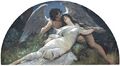 Unknown title and year
 -
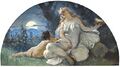 Day, unknown year
 -
 Portrait of the old Emperor Franz Joseph in the regalia of the Order of the Golden Fleece, 1903


_-_Pob%C5%99e%C5%BE%C3%AD.jpg&filetimestamp=20260519013544&)


.png&filetimestamp=20260519013400&)


المراجع
- ^ أ ب ت ث ج "Adolf Liebscher" (in Czech). Sdružení Liebscher. Archived from the original on 14 February 2015. Retrieved 10 May 2014.
{{cite web}}: CS1 maint: unrecognized language (link)
للاستزادة

- Vilém Weitenweber, Adolf Liebscher, in "Zlatá Praha" (1885) Vol.5, No.19 pg.258 [1]
- Z kulturního světa, in "Zlatá Praha" (1919), Vol.6, No.36 pg.334 [2]
- Adolf Liebscher, in "Humoristické listy" (1887), Vol.12, No.29 pg.436 [3]
![[1]](http://archiv.ucl.cas.cz/index.php?path=ZlataPrahaII/2.1885/19/258.png)
![[2]](http://archiv.ucl.cas.cz/index.php?path=ZlataPrahaII/36.1918-1919/41-42/334.png)
![[3]](http://archiv.ucl.cas.cz/index.php?path=HumL/29.1887/49/436.png)
وصلات خارجية
 Media related to أدولف ليبشر at Wikimedia Commons
- ArtNet: More works by Liebscher
- Short description with empty Wikidata description
- Biography with signature
- Wikipedia articles with nonstandard pronunciation
- Articles needing IPA cleanup
- مواليد 1857
- وفيات 1919
- 19th-century Czech painters
- Czech male painters
- 20th-century Czech painters
- Painters from Prague
- Burials at Vyšehrad Cemetery
- 19th-century Czech male artists
- 20th-century Czech male artists
- Painters from Austria-Hungary