حسون الظالم
 حسون الظالم | |
|---|---|
 Male in Scotland | |
| [[ملف: Female in the Netherlands | |
| حالة الحفظ | |
 أنواع غير مهددة أو خطر انقراض ضعيف جدا (IUCN 3.1)[2] | |
| المرتبة التصنيفية | نوع [1] |
| التصنيف العلمي | |
| النطاق: | |
| المملكة: | |
| الشعبة: | |
| الطائفة: | |
| الرتبة: | عصفوريات Passeriformes
|
| الفصيلة: | شرشوريات Fringillidae
|
| الجنس: | Fringilla
|
| النوع: | حسون الظالم
|
| الاسم العلمي | |
| Fringilla coelebs [1] Linnaeus، 1758 | |
 Distribution map Summer Resident Winter Introduced Now treated as separate species: canariensis, moreletti and maderensis spodiogenys | |
 معرض صور حسون الظالم - ويكيميديا كومنز معرض صور حسون الظالم - ويكيميديا كومنز
| |
تعديل  |
|
_female_Drenthe.jpg&filetimestamp=20260602035144&)


الحسون الظالم ويسمى أيضاً عصفور ظالم[3] أو الصغنج[4] أو الشرشور (الاسم العلمي: Fringilla coelebs) إنگليزية: Common Chaffinch هو طائر ينتمي إلى شرشوريات (فصيلة: Fringillidae)، شائع جداً في جميع أنحاء أوروبا. يتواجد في غرب آسيا وشمال غرب أفريقيا وجزر الكناري وجزر ماديرا. وعلى الرغم من أنه شائع في الحدائق وبالأراضي الزراعية، لكنه يفضل الغابات المفتوحة، وهو يبني أعشاشه في الأشجار ويزينها بحيث تصبح أكثر تمويهاً، ويضع حوالي ستة بيضات. يترك الحسون الظالم المناطق الباردة في فصل الشتاء، حيث تغادر بعض الإناث، ويبقى الكثير من الذكور.
تشمل فروعه 3 أنواع متميزة:
- madeirensis، من جزر ماديرا.
- North Africana، من شمال أفريقيا.
- tintillon، من جزر الكناري.
Description
The Eurasian chaffinch is about 14.5 cm (5.7 in) long, with a wingspan of 24.5–28.5 cm (9.6–11.2 in) and a weight of 18–29 g (0.63–1.02 oz).[5] The adult male of the nominate subspecies has a black forehead and a blue-grey crown, nape and upper mantle. The rump is a light olive-green; the lower mantle and scapulars form a brown saddle. The side of head, throat and breast are a dull rust-red merging to a pale creamy-pink on the belly. The central pair of tail feathers are dark grey with a black shaft streak. The rest of the tail is black apart from the two outer feathers on each side which have white wedges.[6] Each wing has a contrasting white panel on the coverts and a buff-white bar on the secondaries and inner primaries.[5] The flight feathers are black with white on the basal portions of the vanes. The secondaries and inner primaries have pale yellow fringes on the outer web whereas the outer primaries have a white outer edge.[6]
After the autumn moult, the tips of the new feathers have a buff fringe that adds a brown cast to the coloured plumage. The ends of the feathers wear away over the winter so that by the spring breeding season the underlying brighter colours are displayed.[6][7] The eyes have dark brown irises and the legs are grey-brown. In winter the bill is a pale grey and slightly darker along the upper ridge or culmen, but in spring the bill becomes bluish-grey with a small black tip.[8]
The male of the subspecies resident in the British Isles (F. c. gengleri) closely resembles the nominate subspecies, but has a slightly darker mantle and underparts.[9]
The adult female is much duller in appearance than the male. The head and most of the upperparts are shades of grey-brown. The underparts are paler. The lower back and rump are a dull olive green. The wings and tail are similar to those of the male. The juvenile resembles the female.[10]
Voice
- Songs
Males typically sing two or three different song types, and there are regional dialects also.[11][12]
The acquisition by the young Eurasian chaffinch of its song was the subject of an influential study by British ethologist William Thorpe. Thorpe determined that if the young common chaffinch is not exposed to the adult male's song during a certain critical period after hatching, it will never properly learn the song. He also found that in adult Eurasian chaffinches, castration eliminates the song, but injection of testosterone induces such birds to sing even in November, when they are normally silent.[13][14]
- Calls
Eurasian chaffinches use between two and eight calls. These calls may vary geographically and their role is not fully understood. Some are used by both sexes all along the year, such as the flight call (tupe) and the separation-alarm call (chink). By contrast, others are used solely in the breeding season. These include the seep female call and the male kseep and tchirp calls. Other calls may be used in when the chaffinches attack other bird near the nest (zzz) and when predators are around (seee and uh-weet calls).[15] The uh-weet call is sometimes labeled rain call. However, the correlation of this call with rainy weather has been challenged by recent research. The uh-weet call correlates better with predator presence in vicinity of calling males, especially when females are around.[16]

Distribution and habitat
The Eurasian chaffinch breeds in wooded areas where the July isotherm is between 12 و 30 °C (54 و 86 °F).[17] The breeding range includes most of Europe and extends eastwards across temperate Asia to the Angara River and the southern end of Lake Baikal in Siberia. The Eurasian chaffinch was introduced from Great Britain into several of its overseas territories in the second half of the 19th century. In New Zealand, the Eurasian chaffinch had colonised both the North and South Islands by 1900 and is now one of the most widespread and common passerine species.[18][19] In South Africa, a very small breeding colony in the suburbs of Constantia, Hout Bay, Pinelands and Camps Bay in Cape Town is the only remnant of another such introduction.[20]
This bird is not migratory in the milder parts of its range, but vacates the colder regions in winter. It forms loose flocks outside the breeding season, sometimes mixed with bramblings. It occasionally strays to eastern North America, although some sightings may be escapees.
Behaviour
Breeding
Eurasian chaffinches first breed when they are one year old. They are mainly monogamous and the pair-bond for residential subspecies such as gengleri sometimes persists from one year to the next.[21] The date for breeding is dependent on the spring temperature and is earlier in southwest Europe and later in the northeast. In Great Britain, most clutches are laid between late April and the middle of June. A male attracts a female to his territory through song.[22]
Nests are built entirely by the female and are usually located in the fork of a bush or a tree several metres above the ground.[23] The nest has a deep cup and is lined with a layer of thin roots and feathers. The outside is covered with a layer of lichen and spider silk over an inner layer of moss and grass. The eggs are laid in early morning at daily intervals until the clutch is complete.[24] The clutch is typically 4–5 eggs, which are smooth and slightly glossy, but very variable in colour. They range from pale-blueish green to light red with purple-brown blotches, spots or steaks. The average size of an egg is 19 mm × 15 mm (0.75 in × 0.59 in) with a weight of 2.2 g (0.078 oz). The eggs are incubated for 10–16 days by the female.[23] The chicks are altricial, hatching nearly naked with closed eyes, and are fed by both parents but mainly by the female, who broods them for around six days.[25] They are mainly fed caterpillars. The nestlings fledge 11–18 days after hatching and disperse. The young birds are then assisted with feeding by both parents for a further three weeks. The parents only very rarely start a second brood, but when they do so it is always in a new nest.[23] Juveniles undergo a partial moult at around five weeks of age in which they replace their head, body and many of their covert feathers, but not their primary and secondary flight feathers.[8] After breeding adult birds undergo a complete annual moult which lasts around ten weeks.[8][26]
In a study carried out in Britain using ring-recovery data, the survival rate for juveniles in their first year was 53 per cent, and the adult annual survival rate was 59 per cent.[27] From these figures the typical lifespan is only 3 years,[28] but the maximum age recorded is 15 years and 6 months for a bird in Switzerland.[29]
-
 Nest of a chaffinch
 -
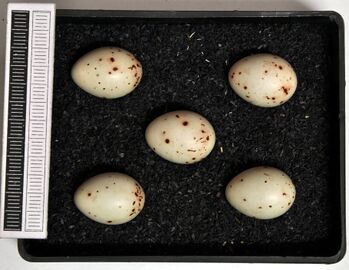 Eggs of Fringilla coelebs coelebs


Feeding
Outside the breeding season, Eurasian chaffinches mainly eat seeds and other plant material that they find on the ground. They often forage in open country in large flocks. Common chaffinches seldom take food directly from plants and only very rarely use their feet for handling food.[30] During the breeding season, their diet switches to invertebrates, especially defoliating caterpillars. They forage in trees and also occasionally make short sallies to catch insects in the air.[30] The young are entirely fed with invertebrates which include caterpillars, aphids, earwigs, spiders and grubs (the larvae of beetles).[30]
Predators and parasites
The eggs and nestlings of the Eurasian chaffinch are predated by crows, Eurasian red and eastern grey squirrels, domestic cats and probably also by stoats and weasels. Clutches begun later in the spring suffer less predation, an effect that is believed to be due to the increased vegetation making nests more difficult to find.[31] Unlike the case for the closely related brambling, the common chaffinch is not parasitised by the common cuckoo.[32]
The protozoal parasite Trichomonas gallinae was known to infect pigeons and raptors, but beginning in Great Britain in 2005, carcasses of dead European greenfinches and common chaffinches were found to be infected with the parasite.[33] The disease spread and in 2008, infected carcasses were found in Norway, Sweden and Finland and a year later in Germany. The spread of the disease is believed to have been mediated by Eurasian chaffinches, as large numbers of the birds breed in northern Europe and winter in Great Britain.[34] In Great Britain, the number of infected carcasses recovered each year declined after a peak in 2006. There was a reduction in the number of European greenfinches but no significant decline in the overall number of common chaffinches.[35] A similar pattern occurred in Finland where, after the arrival of the disease in 2008, there was a reduction in the number of European greenfinches, but only a small change in the number of Eurasian chaffinches.[36]
Eurasian chaffinches can develop tumors on their feet and legs caused by the Fringilla coelebs papillomavirus.[37][38] The size of the papillomas range from a small nodule on a digit to a large growth involving both the foot and the leg. The disease is uncommon: in a 1973 study undertaken in the Netherlands, of around 25,000 common chaffinches screened, only 330 bore papillomas.[37]
Status
The Eurasian chaffinch has an extensive range, estimated at 7 million square kilometres (3.7 million square miles) and a large population including an estimated 130–240 million breeding pairs in Europe. Allowing for the birds breeding in Asia, the total population lies between 530 and 1,400 million individuals. There is no evidence of any serious overall decline in numbers, so the species is classified by the International Union for Conservation of Nature as being of Least Concern.[39]
Relationship to humans

The Eurasian chaffinch was once popular as a caged songbird and large numbers of wild birds were trapped and sold.[40] At the end of the 19th century, trapping even depleted the number of birds in London parks.[41] In 1882, the English publisher Samuel Orchart Beeton issued a guide on the care of caged birds and included the recommendation: "To parents and guardians plagued with a morose and sulky boy, my advice is, buy him a chaffinch."[40] Competitions were held where bets were placed on which caged common chaffinch would repeat its song the greatest number of times. The birds were sometimes blinded with a hot needle in the belief that this encouraged them to sing.[42] This practice is the subject of the poem The Blinded Bird by the English author Thomas Hardy, which contrasts the cruelty involved in blinding the birds with their zestful song.[43] In Great Britain, the practice of keeping Eurasian chaffinches as pets declined after the trapping of wild birds was outlawed by the Wild Birds Protection Acts of 1880 to 1896.[43][44]
The Eurasian chaffinch is still a popular pet bird in some European countries. In Belgium, the traditional sport of vinkenzetting pits male Eurasian chaffinches against one another in a contest for the most bird calls in an hour.[45]
طالع أيضًا
مراجع
- ^ أ ب ت ث ج Imported from Wikidata item: https://www.wikidata.org/wiki/Q25383
- ^ BirdLife International (2019). "Fringilla coelebs". IUCN Red List of Threatened Species. 2019 e.T22720030A155432370. doi:10.2305/IUCN.UK.2018-2.RLTS.T22720030A155432370.en. Retrieved 12 November 2021.
{{cite journal}}: Unknown parameter|amends=ignored (help) - ^ أعمار الطيور حيوانات الكويت، تاريخ الولوج 25/07/2009
- ^ لائحة الأنواعWildlife - Palestine، تاريخ الولوج 05/08/2009
- ^ أ ب Cramp (1994), p. 448.
- ^ أ ب ت Cramp (1994), pp. 467–468.
- ^ Newton (1972), p. 19.
- ^ أ ب ت Cramp (1994), p. 469.
- ^ Cramp (1994), pp. 472–473.
- ^ Cramp (1994), p. 449.
- ^ Metzmacher, M.; Mairy, F. (1972). "Variations géographiques de la figure finale du chant du Pinson des arbres (Fringilla c. coelebs L.)". Le Gerfaut (in الفرنسية). 62: 215–244. hdl:2268/162278.
- ^ Metzmacher, M. (2016). "Imitations et transmission culturelle dans le chant du Pinson des arbres Fringilla coelebs ?". Alauda (in الفرنسية). 84: 203–220. hdl:2268/204048.
- ^ Thorpe, W. (1958). "The learning of song patterns by birds, with special reference to the song of the Chaffinch, Fringilla coelebs". Ibis. 100 (4): 535–570. doi:10.1111/j.1474-919X.1958.tb07960.x.
- ^ Metzmacher, M. (1995). "La transmission du chant chez le Pinson des arbres (Fringilla c. coelebs): phase sensible et rôle des tuteurs chez les oiseaux captifs" (PDF). Alauda (in الفرنسية). 63 (2): 123–134.
- ^ Marler, Peter (2004). "5.Bird calls: a cornucopia for communication". In Peter, Marler; Hans, Slabbekoorn (eds.). Nature's music, the science of birdsong. Academic Press. pp. 133–134. doi:10.1016/B978-012473070-0/50008-6. ISBN 978-0-12-473070-0.
- ^ de Framond, Léna (2025). "Decoding the chaffinch "rain" call: a female-directed alarm call?". Behavioral Ecology. 36 (4). doi:10.1093/beheco/araf039. PMC 12137894. PMID 40475239.
{{cite journal}}: Check|pmc=value (help); Check|pmid=value (help) - ^ Cramp (1994), p. 450.
- ^ Baker, Allan J.; Peck, Mark K.; Goldsmith, Margaret A. (1990). "Genetic and morphometric differentiation in introduced populations of Common Chaffinches (Fringilla coelebs) in New Zealand" (PDF). The Condor. 92 (1): 76–88. doi:10.2307/1368385. JSTOR 1368385.
- ^ Higgins, P.J.; Peter, J.M.; Cowling, S.J., eds. (2006). "Fringilla coelebs Common Chaffinch" (PDF). Handbook of Australian, New Zealand and Antarctic Birds. Volume 7: Boatbill to Starlings. Melbourne: Oxford University Press. pp. 1305–1315 [1308]. ISBN 978-0-19-555885-2.
- ^ Brooke, R.K. (1997). "Chaffinch, Gryskoppie Fringilla coelebs". In Harrison, J.A.; et al. (eds.). Atlas of South African Birds, Volume 2: Passerines (PDF). Johannesburg: BirdLife South Africa. p. 648. ISBN 0-620-20731-0.
- ^ Cramp (1994), p. 457.
- ^ Newton (1972), p. 137.
- ^ أ ب ت Cramp (1994), pp. 466–467.
- ^ Newton (1972), p. 141.
- ^ Newton (1972), pp. 141–142.
- ^ Newton 1972, p. 257, Appendix 11.
- ^ Siriwardena, G.M.; Baillie, S.R.; Wilson, J.D. (1998). "Variation in the survival rates of some British passerines with respect to their population trends on farmland". Bird Study. 45 (3): 1998. Bibcode:1998BirdS..45..276S. doi:10.1080/00063659809461099.
- ^ "Chaffinch Fringilla coelebs [Linnaeus, 1758]". Bird Facts. British Trust for Ornithology. 7 April 2015. Retrieved 31 August 2023.
- ^ "European Longevity Records". Euring. Archived from the original on 2 June 2013. Retrieved 15 September 2013.
- ^ أ ب ت Cramp 1994, pp. 455-456.
- ^ Newton (1972), p. 145.
- ^ Newton 1972, p. 28.
- ^ Robinson, R.A.; et al. (2010). "Emerging infectious disease leads to rapid population declines of common British birds". PLOS ONE. 5 (8) e12215. Bibcode:2010PLoSO...512215R. doi:10.1371/journal.pone.0012215. PMC 2923595. PMID 20805869.
- ^ Lawson, B.; et al. (2011). "Evidence of spread of emerging infectious disease, finch trichomonosis, by migrating birds". Ecohealth. 8 (2): 143–153. doi:10.1007/s10393-011-0696-8. PMID 21935745. S2CID 13343152.
- ^ Lawson, B.; et al. (2012). "The emergence and spread of finch trichomonosis in the British Isles". Philosophical Transactions of the Royal Society B. 367 (1604): 2852–2863. doi:10.1098/rstb.2012.0130. JSTOR 41740010. PMC 3427565. PMID 22966140.
- ^ Lehikoinen, A.; Lehikoinen, E.; Valkama, J.; Väisänen, R.A.; Isomursu, M. (2013). "Impacts of trichomonosis epidemics on Greenfinch Chloris chloris and Chaffinch Fringilla coelebs populations in Finland". Ibis. 155 (2): 357–366. doi:10.1111/ibi.12028.
- ^ أ ب Lina, P.H.; van Noord, M.J.; de Groot, F.G. (1973). "Detection of virus in squamous papillomas of the wild bird species Fringilla coelebs". Journal of the National Cancer Institute. 50 (2): 567–571. doi:10.1093/jnci/50.2.567. PMID 4702127.
- ^ Terai, M.; DeSalle, R.; Burk, R.D. (2002). "Lack of canonical E6 and E7 open reading frames in bird papillomaviruses: Fringilla coelebs papillomavirus and Psittacus erithacus timneh papillomavirus". Journal of Virology. 76 (19): 10020–10023. doi:10.1128/JVI.76.19.10020-10023.2002. PMC 136527. PMID 12208979.
- ^ "Eurasian Chaffinch Fringilla coelebs". Species factsheet. BirdLife International. Retrieved 6 September 2013.
- ^ أ ب Beeton, Samuel Orchart (1862). Beeton's book of birds: showing how to manage them in sickness and in health. London: Self-published. pp. 261–274.
- ^ Hudson, William Henry (1898). Birds in London. London: Longmans, Green and Co. p. 198.
- ^ Albin, Eleazar (1737). A Natural History of English Song-birds. London: A. Bettesworth and C. Hitch. pp. 25–26.
- ^ أ ب Cocker, Mark; Mabey, Richard (2005). Birds Britannica. London: Chatto and Windus. pp. 443–445. ISBN 978-0-7011-6907-7.
- ^ Marchant, James Robert Vernam; Watkins, Watkin (1897). Wild Birds Protection Acts, 1880-1896. London: R.H. Porter.
- ^ Dan, Bilefsky (21 May 2007). "One-Ounce Belgian Idols Vie for Most Tweets per Hour". The New York Times. Retrieved 15 August 2013.


- CS1 errors: unsupported parameter
- Cite iucn maint
- Harv and Sfn no-target errors
- CS1 الفرنسية-language sources (fr)
- CS1 errors: PMC
- CS1 errors: PMID
- أنواع القائمة الحمراء غير المهددة
- حالة حفظ مختلفة عن ويكي بيانات
- صفحات بها بيانات ويكي بيانات
- صفحات بها مراجع ويكي بيانات
- صفحات تستخدم خاصية P105
- تسمية علمية same as Wikidata
- صفحات تستخدم خاصية P935
- Articles containing إنگليزية-language text
- Pages using Lang-xx templates
- بذرة طيور
- طيور أوروپا
- فينش
- طيور المغرب
- طيور مصر
- طيور أفريقيا
- طيور منزلية أليفة