نباتات فوقية

_and_Impatiens_in_Costa_Rica.jpg&filetimestamp=20100706202633&)
النباتات الفوقية epiphytes، وتسمى بالنباتات السطحية، هي نباتات تَغْرِس جذورها فوق جذوع الأشجار أو فوق أغصانها العليا أو على الصخور وسطوح المنازل وأسلاك الهاتف للحصول على الإنارة اللازمة لنموها معتمدة الأشجار ركيزة لنموها، أي تقضي حياتها مثبتة أو محمولة فوق نباتات أخرى أو على سطوحها، تستخدمها مساند أو دعائم، أو مصدراً لتغذيتها المعدنية المكونة من ماء وأملاح معدنية وغاز ثنائي أكسيد الكربون. فالنباتات الفوقية تتطفل على المكان فقط، وهي غير النباتات الطفيلية التي تستمد غذاءها من النبات المضيف.
تحمل النباتات الفوقية أعضاء بالغة التخصص، قادرة على التغذية الكربونية القائمة على التركيب الضوئي، أما التغذية المعدنية فتتم بامتصاص الأملاح المنحلة في ماء المطر بوساطة جذور هوائية مثبتة على نبات حامل أو على سلك معدني.
نبات الـتيلاندسيا Tillandsia من الفصيلة البروملية Bromeliaceae تحمل سوقُه وأوراقُه أوباراً ماصة معقدة عديدة الخلايا مغروسة في النسج النباتية، ومنتشرة على سطحه وممتدة في الهواء مغطية غلفها الخارجية بمادة سميكة لزجة جاذبةً ما يلامسها من بخار ماء وندى وأمطار. ونبات الفانيليا من الفصيلة السحلبية ، والمونستيرا Monstera من الفصيلة القلقاسية (المستعمل نبات زينة في البيوت الزجاجية من أصول مكسيكية تزرع للتغذية بثمارها) يرسل كل منهما في الهواء جذوراً طويلة تغطيها نسج خلوية خارجية ميتة مملوءة بالهواء المُرَطَّب بالندى والضباب ومياه الأمطار، وتتبعها نسج داخلية حية إسفنجية محتفظة بالماء الضروري للنبات تدعى غشاء الجذر velamen radicum. ونبات النيدولاريوم Nidularium من الفصيلة البروميلية له أوراق حمراء محيطة بالأزهار مكونة قدحاً يحتفظ بقرابة نصف لتر من ماء الندى أو المطر الضروري لحياة النبات مدة طويلة.

تحمل بعض أنواع الفصيلة السحلبية أوباراً ماصة موضوعة في «مخازن» مائية ورقية بصلية الشكل. وكما تستمد بعض النباتات السطحية الماء من الدبال المشبع بمياه الأمطار المتراكم في قاعدة النبات كما في السرخس Platycerium الذي يذوي نباته البوغي إذا ما فُقِدَت المادة الدبالية.

دلت التحاليل الكيمياوية في نبات التيلانديزيا على عدم اختلاف مكوِّنات رماد النباتات النامية فوق الأسلاك ـ والحاصلة على تغذية معدنية مستمدة من أوبار ماصة ورقية ـ عن محتويات النباتات النامية فوق تربة طبيعية مستمدة التغذية المعدنية بوساطة أوبار ماصة جذرية.


النباتات الفوقية الأرضية

يغزر انتشار النباتات الفوقية في الغابات الماطرة المدارية التي تمنع وصول الضوء إلى المستويات الأرضية. وهي تشمل عدداً كبيراً من مغلفات البذور والسراخس والحزاز وكثيراً من النباتات الصغيرة المتكيفة مع العيش على جذوع الأشجار. وتتمثل النباتات الفوقية المنتشرة في المناطق المعتدلة بالأشن Lichens والحزازيات Mousses من البريويات.
A monograph on epiphytic plant ecology was written by A. F. W. Schimper (Die epiphytische Vegetation Amerikas, 1888).[citation needed] Assemblages of large epiphytes occur most abundantly in moist tropical forests, but mosses and lichens occur as epiphytes in almost all biomes.[1] In Europe there are no dedicated epiphytic plants using roots, but rich assemblages of mosses and lichens grow on trees in damp areas (mainly the western coastal fringe), and the common polypody fern grows epiphytically along branches.[citation needed] Rarely, grass, small bushes or small trees may grow in suspended soils up trees (typically in a rot-hole).[citation needed]
-
 Epiphytes can grow on the trunks of trees or sometimes in the canopy of a tree
 -
 An epiphytic orchid on a tree in a Brazilian cloud forest
 -
 Clinging root of an orchid
 -
 Plants in a conservatory, including a Neoregelia bromeliad (upper left), several Rhipsalis species (lower center), and other epiphytes
.jpg&filetimestamp=20260519142834&)


النباتات الفوقية الهوائية ونصف الهوائية

Epiphytes can generally be categorized into holo-epiphytes or hemi-epiphytes. A holo-epiphyte is a plant that spends its whole life cycle without contact with the ground and a hemi-epiphyte is a plant that spends only half of its life without the ground before the roots can reach or make contact with the ground.[2] Orchids are a common example of holo-epiphytes[3] and strangler figs are an example of hemi-epiphytes[4].
العلاقات المغذية للنبات
Epiphytes are not connected to the soil, and consequently must get nutrients from other sources, such as fog, dew, rain and mist,[5] or from nutrients being released from the ground rooted plants by decomposition or leaching, and dinitrogen fixation.[5] Epiphytic plants attached to their hosts high in the canopy have an advantage over herbs restricted to the ground where there is less light and herbivores may be more active. Epiphytic plants are also important to certain animals that may live in their water reservoirs, such as some types of frogs and arthropods. [6][7]
Epiphytes can have a significant effect on the microenvironment of their host, and of ecosystems where they are abundant, as they hold water in the canopy and decrease water input to the soil.[8] Some non-vascular epiphytes such as lichens and mosses are well known for their ability to take up water rapidly.[9] Epiphytes create a significantly cooler and more moist environment in the host plant canopy, potentially greatly reducing water loss by the host through transpiration. [citation needed]
أيض النبات
CAM metabolism, a water-preserving metabolism present among various plant taxa, is particularly relevant to epiphytic communities.[10] For example, it is estimated that among epiphytic orchids, as many as 50% are likely to use it.[11] Other relevant epiphytic families which display such metabolism are Bromeliacee (e.g. in genera Aechmea and Tillandsia), Cactaceae (e.g. in Rhipsalis and Epiphyllum) and Apocynaceae (e.g. in Hoya and Dischidia). [citation needed]
النباتات الفوقية البحرية
The ecology of epiphytes in marine environments differs from those in terrestrial ecosystems. Epiphytes in marine systems are species of algae, bacteria, fungi, sponges, bryozoans, ascidians, protozoa, crustaceans, molluscs and any other sessile organism that grows on the surface of a plant, typically seagrasses or algae.[12][13] Settlement of epiphytic species is influenced by a number of factors including light, temperature, currents, nutrients, and trophic interactions. Algae are the most common group of epiphytes in marine systems.[13] Photosynthetic epiphytes account for a large amount of the photosynthesis in systems in which they occur.[14] This is typically between 20 and 60% of the total primary production of the ecosystem.[13] They are a general group of organisms and are highly diverse, providing food for a great number of fauna.[14] Snail and nudibranch species are two common grazers of epiphytes.[13] Epiphyte species composition and the amount of epiphytes can be indicative of changes in the environment. Recent increases in epiphyte abundance have been linked to excessive nitrogen put into the environment from farm runoff and storm water. High abundance of epiphytes are considered detrimental to the plants that they grow on often causing damage or death, particularly in seagrasses.[12] This is because too many epiphytes can block access to sunlight or nutrients. Epiphytes in marine systems are known to grow quickly with very fast generation times.[15]
-
 Heavy epiphyte growth on kelp stipe
 -
 Notheia anomala growing on Hormosira banksii
 -

-
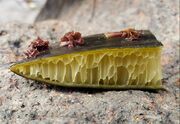 Cross-section of a Durvillaea antarctica frond, showing Pyrophyllon subtumens growing on the outer surface


انظر أيضاً
- Epiphyllum - جنس من صبار الأوركيد
- نبات طفيلي
- Raunkiær plant life-form
المصادر
وصلات خارجية

| Epiphytes
]].- ^ Fialová, Lucie; Plášek, Vítezslav; Klichowska, Ewelina; Guo, Shuiliang; Nobis, Marcin (January 3, 2023). "Temperature and Precipitation More Than Tree Cover Affect the Distribution Patterns of Epiphytic Mosses within the Orthotrichaceae Family in China and Adjacent Areas". Plants. 12 (1): 1:2 – via MDPI.
- ^ Nieder, Jürgen; Prosper´ı, Juliana (2001). "Epiphytes and their contribution to canopy diversity". Plant Ecology. 153 (1–2): 51–63. Bibcode:2001PlEco.153...51N. doi:10.1023/A:1017517119305. S2CID 37082364.[dead link]
- ^ "What are epiphytes?". Trees That Count (in الإنجليزية). Retrieved 2026-01-08.
- ^ mathieu (2022-05-26). "Strangler figs, essential trees". Morpho Evasions Costa Rica (in الإنجليزية الأمريكية). Retrieved 2026-01-08.
- ^ أ ب Zotz, Gerhard; Hietz, Peter (November 2001). "The physiological ecology of vascular epiphytes: current knowledge, open questions". Journal of Experimental Botany. 52 (364): 2067–2078. doi:10.1093/jexbot/52.364.2067. PMID 11604445. S2CID 22635086.
- ^ Romero, Gustavo Q.; Nomura, Fausto; Gonçalves, Ana Z.; Dias, Natacha Y. N.; Mercier, Helenice; Conforto, Elenice de C.; Rossa-Feres, Denise de C. (December 19, 2009). "Nitrogen fluxes from treefrogs to tank epiphytic bromeliads: an isotopic and physiological approach". Plant - Animal Interactions. 162: 942:948 – via Springer Nature Link.
- ^ Yanoviak, Stephen P.; Nadkarni, Nalini M.; Gering, Jon C. (April 2, 2002). "Arthropods in epiphytes: a diversity component that is not effectively sampled by canopy fogging". Biodiversity and Conservation. 12: 732:733 – via Springer Nature Link.
- ^ Stanton, D.E.; Chávez, J.H.; Villegas, L.; Villasante, F.; Armesto, J.; Hedin, L.O.; Horn, H. (2014). "Epiphytes Improve Host Plant Water Use by Microenvironment Modification". Functional Ecology. 28 (5): 1274–1283. Bibcode:2014FuEco..28.1274S. doi:10.1111/1365-2435.12249. hdl:10533/148493.
- ^ Johansson, Dick (1974). "ECOLOGY OF VASCULAR EPIPHYTES IN WEST AFRICAN RAIN FOREST" (PDF). Acta Phytogeographica Suecica. 59.
- ^ Zotz, Gerhard; Andrade, José Luis; Einzmann, Helena J R (2023-01-07). "CAM plants: their importance in epiphyte communities and prospects with global change". Annals of Botany. 132 (4): 685–698. doi:10.1093/aob/mcac158. ISSN 0305-7364. PMC 10799991. PMID 36617243.
- ^ Winter, Klaus; Smith, J. Andrew C., eds. (1996). Crassulacean Acid Metabolism. Ecological Studies (in الإنجليزية). Vol. 114. doi:10.1007/978-3-642-79060-7. ISBN 978-3-642-79062-1. ISSN 0070-8356.
- ^ أ ب "MV Commission" (PDF).
- ^ أ ب ت ث "www.SeagrassLI.org Cornell Cooperative Extension Eelgrass Restoration". www.seagrassli.org. Archived from the original on 2017-04-25. Retrieved 2017-06-26.
- ^ أ ب "Marine Plants / Algae - Biscayne National Park (U.S. National Park Service)". www.nps.gov (in الإنجليزية). Retrieved 2017-06-26.
- ^ "An Assessment of Coastal Hypoxia and Eutrophication in U.S. Waters" (PDF). NOAA. Archived from the original (PDF) on 2017-05-07. Retrieved 2017-06-26.
- Short description is different from Wikidata
- Articles containing ألمانية-language text
- Articles with unsourced statements from November 2025
- Articles with unsourced statements from August 2025
- Ecological definitions
- نباتات هوائية
- علم أشكال النبات
- Articles with dead external links from January 2022
- CS1 الإنجليزية الأمريكية-language sources (en-us)