ضريح أبو لؤلؤة المجوسي
| Shrine of Abu Lu'lu'a | |
|---|---|
بقعه ابولولو | |
 The closed mausoleum, in 2017, with iwan and conical dome | |
| الدين | |
| الارتباط | Shia Islam (closed) |
| العيد | Omar Koshan |
| الوضع الكنسي أو التنظيمي | Mausoleum and shrine (closed since 2007) |
| الوضع | Closed (since 2007) |
| الموقع | |
| الموقع | Kashan, Isfahan province |
| البلد | Iran |
  Location of the closed shrine in Iran | |
| الإحداثيات الجغرافية | 33°58′11″N 51°25′00″E / 33.96972°N 51.41667°E |
| العمارة | |
| النوع المعماري | Islamic architecture |
| النمط المعماري | |
| اكتمل | |
| المواصفات | |
| المساحة الداخلية | 200 m2 (2،200 sq ft) |
| القباب | One: conical |
| ارتفاع القبة (الخارجي) | 19 m (62 ft) |
| مساحة الموقع | 1،000 m2 (0.25 acre) |
| الأضرحة | One: Abu Lu'lu'a Firuz (d. 644) |
| المواد | Adobe; bricks; mortar; tiles |
| الارتفاع | 956 m (3،136 ft) |
| [1][2] | |
The Shrine of Abu Lu'lu'a (فارسية: بقعه ابولولو), also known as the Shrine of Bābā Shujāʿ al-Dīn (بقعه بابا شجاع الدين)[3] is a closed mausoleum and shrine located in Kashan, in the province of Isfahan, Iran.[4] The shrine was built over what is popularly believed to be the final resting place of Abu Lu'lu'a Firuz, a Persian slave who assassinated the second Islamic caliph Umar ibn al-Khattab in 644 CE.[5]
The structure dates from the Mongol era (13th–15th century),[2] and during the 16th century it became the central location of a yearly festival celebrating Abu Lu'lu'a, called Omar Koshan ("the Killing of Umar").
The mausoleum was added to the Iran National Heritage List on 6 September 1975 and is administered by the Cultural Heritage, Handicrafts and Tourism Organization of Iran.[بحاجة لمصدر] Due to pressure from the International Union of Muslim Scholars, the Iranian government closed the complex in 2007.[1]
Architecture
The original structure was built before the Safavid period (1501–1736), at some time during the Mongol era (13th–15th century).[2] However, the building's dome and iwan date from the Safavid period or later.[2]
Festival
The historical Abu Lu'lu'a died in Medina (the capital of the early caliphate, situated in the Arabian Peninsula) shortly after his assassination of Umar ibn al-Khattab in 644 CE.[6] At some later time, legends arose according to which Abu Lu'lu'a was saved from his pursuers by Ali ibn Abi Talib (the cousin and son-in-law of the prophet Muhammad, who is also revered by Shi'ite Muslims as the first Imam). According to these stories, Ali instantaneously transported Abu Lu'lu'a by means of a special prayer to Kashan, where he married and lived out the rest of his life.[7]
During the 16th-century Safavid conversion of Iran to Shia Islam, a festival started to be celebrated in honor of Abu Lu'lu'a, commemorating his assassination of Umar.[8] Named Omar Koshan (حرفياً 'the killing of Umar'), it was originally held around Abu Lu'lu'a's sanctuary in Kashan, each year at the anniversary of Umar's death (26 Dhu al-Hijja of the Islamic year).[9] Later it also started to be celebrated elsewhere in Iran, sometimes on 9 Rabi' al-Awwal rather than on 26 Dhu al-Hijja.[10] The festival celebrated Abu Lu'lu'a, nicknamed for the occasion Bābā Shujāʿ al-Dīn (حرفياً 'Father Courageous of the Faith'), as a national hero who had defended the religion by killing the oppressive caliph.[11]
Due to political sensitivities, from the Qajar period (1789–1925) onward the festival gradually stopped being celebrated in the major cities of Iran, until it was eventually banned officially by the Islamic Republic of Iran in 1979.[12] Nevertheless, the festival itself is still celebrated in Iran, though often secretly and indoors rather than outdoors.[13] It is now held on the 9th day of the month of Rabi' Al-Awwal of the Islamic year, lasting until the 27th of the same month.[14]
Controversy
In the mid-2000s, controversy was caused when al-Azhar University demanded the Iranian government demolish Abu Lu'lu'a's shrine, because the shrine was considered to be "offensive and un-Islamic" by mainstream Sunni scholars. The issue caused the cancellation of diplomatic relations between the university and the Iranian government.[15] The Iranian government closed the shrine in 2007 as a result of Sunni pressure, including an intervention by the International Union for Muslim Scholars.[1]
Gallery
-
 View of the conical dome
 -
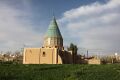 The shrine in 2015


See also
References
- ^ أ ب ت Isma'il 2007, referred to by Ismail 2016, p. 93; Ali 2018.
- ^ أ ب ت ث Anonymous 1975. Quote: "اصل بنا احتمالا مربوط به دوران قبل از صفويه وبقول به دوران مغول ميرسد ولى گنبد وايوان آن ازبناهاى دوران صفويه ودورانهاى بعد مياشد.".
- ^ Anonymous 1975.
- ^ Algar 1990
- ^ On Abu Lu'lu'a, see Pellat 2011.
- ^ Pellat 2011.
- ^ Fischer 1980, p. 16; Johnson 1994, p. 127, note 23. According to Ali 2018, the earliest version of the transportation story as related by Imād al-Dīn Ṭabarī in his Kāmil-e Bahāī (675 AH = 1276–7 CE) mentioned a mystical transportation to Qom, but later the story was changed to Abu Lu'lu'a's being transported to Kashan instead, possibly to authenticate the presence of the mausoleum in Kashan.
- ^ Algar 1990; Torab 2007, p. 196.
- ^ Johnson 1994, p. 127, note 23; cf. Algar 1990.
- ^ Calmard 1996, p. 161; Algar 1990.
- ^ Calmard 1996, p. 161; Johnson 1994, p. 127, note 23; Torab 2007, p. 196.
- ^ Algar 1990; Torab 2007, pp. 194–195.
- ^ Torab 2007, p. 195.
- ^ Torab 2007, p. 198.
- ^ Ismail 2016, p. 93.
Bibliography
- Algar, Hamid (1990). "Caliphs and the Caliphate, as viewed by the Shiʿites of Persia". In Yarshater, Ehsan (ed.). Encyclopædia Iranica, Volume IV/7: Calendars II–Cappadocia. London and New York: Routledge & Kegan Paul. pp. 677–679. ISBN 978-0-71009-130-7.
- Ali, Sayyid (12 November 2018). "Is Abu Lulu Buried in Kashan?". Iqra Online.
- "بقعه ابولولو / ۱۰۹۱" (PDF). دانشنامهی تاریخ معماری و شهرسازی ایران [Encyclopaedia of the History of Architecture and Urban Planning of Iran]. Registration no. 1091 (in Persian). Ministry of Roads and Urban Development. 6 September 1975 [15 Shahrivar 1354 SH].
{{cite book}}: CS1 maint: unrecognized language (link) - Calmard, Jean (1996). "Shi'i Rituals and Power II. The Consolidation of Safavid Shi'ism: Folklore and Popular Religion". In Melville, Charles (ed.). Safavid Persia: The History and Politics of an Islamic Society. Pembroke Persian Papers. Vol. 4. London: I.B. Tauris. pp. 139–190. ISBN 1-86064-023-0.
- Fischer, Michael M. J. (1980). Iran: From Religious Dispute to Revolution. Cambridge, MA: Harvard University Press. ISBN 9780674466159.
- Isma'il, Faraj (13 June 2007). "بعد تدخل الاتحاد العالمي لعلماء المسلمين : السلطات الإيرانية تغلق مزار "أبو لؤلؤة المجوسي" قاتل عمر بن الخطاب". Al Arabiya. Archived from the original on 15 June 2007.
{{cite web}}: CS1 maint: unfit URL (link) - Ismail, Raihan (2016). Saudi clerics and Shī'a Islam. New York: Oxford University Press. ISBN 9780190627508.
- Johnson, Rosemary Stanfield (1994). "Sunni Survival in Safavid Iran: Anti-Sunni Activities During the Reign of Tahmasp I". Iranian Studies. 27 (1–4): 123–133. doi:10.1080/00210869408701823. JSTOR 4310889.
- Pellat, Charles (2011). "Abū Loʾloʾa". In Yarshater, Ehsan (ed.). Encyclopaedia Iranica.
- Torab, Azam (2007). Performing Islam: Gender and Ritual in Iran. Leiden: Brill. doi:10.1163/9789047410546_009.
Further reading
- Nārāqī, Ḥasan (1928). Āsār-i tārikhī-i shahristānhā-yi Kāshān va Naṭanz (in الفارسية). Tehran: Anjumān-i āsār-i millī. pp. 186–188.
External links
 Media related to Shrine of Abu Lu'lu'a at Wikimedia Commons
- "Boqe-ye Abululu". Iranshahr Encyclopedia of Iranian Architectural History. Retrieved 23 November 2010.
- "ABU LOLO (BABA SHOJA-EDIN) MAUSOLEUM". Iran Tourism and touring Organization. 2025. Retrieved 14 June 2025.
- "Imamzadah Abu Lu'lu'". ArchNet.org. n.d. Retrieved 14 June 2025.


- Pages using gadget WikiMiniAtlas
- Articles containing فارسية-language text
- Short description with empty Wikidata description
- Coordinates not on Wikidata
- مقالات ذات عبارات بحاجة لمصادر
- Articles with hatnote templates targeting a nonexistent page
- Pages with empty portal template
- CS1 maint: unfit URL
- CS1 الفارسية-language sources (fa)
- 2007 disestablishments in Iran
- 14th-century religious buildings and structures in Iran
- Buildings and structures completed in 1375
- Buildings and structures in Kashan
- Buildings of the Qajar period
- Ilkhanid architecture
- Mausoleums in Iran
- Mausoleums, shrines and tombs on the Iran National Heritage List
- Religious buildings and structures completed in the 1370s
- Safavid architecture in Iran
- Shia Islam in Iran
- Shia shrines
- Shrines in Iran